The density matrix: what the state vector misses
A pure state fits in a vector. A noisy state, or one qubit of an entangled pair, does not. Density matrices, quantum channels, and what they show that vectors miss.

For most of this series, a quantum state has been a vector. A short list of amplitudes, one slot per outcome, that I could write down and reason about by hand. The state |0⟩, the superposition (|0⟩ + |1⟩)/√2, a Bell state across two qubits, the standard entangled pair. That picture is correct, and it carries you a long way. It also runs out of room, and this badge is about the language that picks up where it stops.
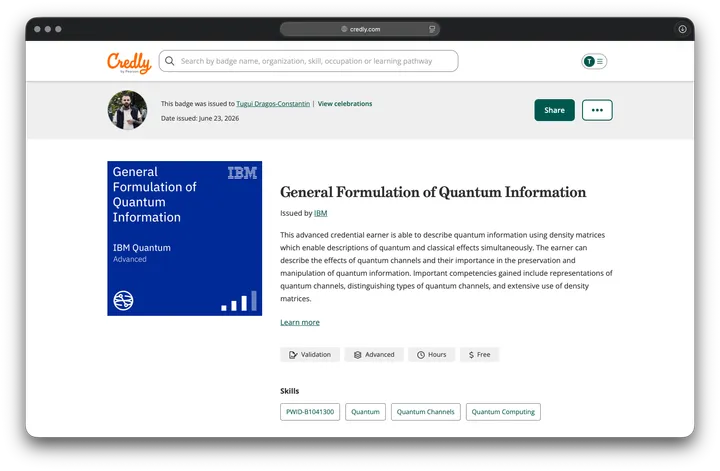
The badge is called General Formulation of Quantum Information. The word that matters is general. A state vector can only describe a system that is pure and on its own. Real qubits are rarely either. They sit inside noise. They are entangled with things you do not control and cannot measure. For those situations you need a bigger object, and that object is the density matrix.
The state vector runs out of room
Here is the gap, concretely. A state vector says: I know exactly what state this qubit is in, even when that state is a superposition. There is no uncertainty about the state itself, only about what a measurement will return.
But suppose I hand you one qubit of an entangled pair and keep the other one myself, somewhere you cannot reach. What state is your qubit in? There is no single vector that answers this. Your qubit does not have a state of its own in the way the vector formalism requires. It only has a state jointly, with mine. The vector language has no slot for "half of an entangled pair," and that is not a small edge case. It is most of real quantum computing, where every qubit is leaking a little of itself into its surroundings whether you like it or not.
What a density matrix is
A density matrix, written ρ, is the more general way to say what state a system is in. For a pure state |ψ⟩ it is just ρ = |ψ⟩⟨ψ|, the outer product, which carries exactly the same information as the vector. Nothing new yet. The new part is that a density matrix can also describe a mixture: not a superposition, but honest classical uncertainty about which of several states you actually have. A coin that is either |0⟩ or |1⟩, fifty fifty, with no quantum coherence, no definite relative phase, between the two, has a density matrix as well, and it is a different object from the superposition (|0⟩ + |1⟩)/√2 even though both give fifty fifty when measured.
One number tells these apart, and I leaned on it constantly while learning this material. It is the purity, Tr(ρ²), the trace being the sum of the diagonal. For a pure state it equals exactly 1. For anything mixed it is less than 1, bottoming out at 0.5 for a single qubit that is maximally mixed, a true coin flip with no information left. Purity is the dial that reads how much quantum certainty a state still holds, and watching it move is how the abstract idea of mixedness became concrete for me.
The result that made it click
I will show you the one calculation that turned this from a definition into an intuition. Take a Bell state, a maximally entangled pair of two qubits. As a whole it is pure. Its purity is exactly 1, no uncertainty at all. Now throw away one of the two qubits and ask what is left.
import numpy as np
from qiskit.quantum_info import Statevector, DensityMatrix, partial_trace, entropy, purity

bell = Statevector([1, 0, 0, 1]) / np.sqrt(2)   # (|00> + |11>) / sqrt(2)
rho = DensityMatrix(bell)
print(round(float(np.real(purity(rho))), 6))       # 1.0  -> the pair is perfectly pure

reduced = partial_trace(rho, [1])                  # ignore qubit 1, keep qubit 0
print(np.round(np.real(reduced.data), 6))          # [[0.5 0. ] [0.  0.5]]
print(round(float(np.real(purity(reduced))), 6))   # 0.5  -> maximally mixed
print(round(float(entropy(reduced, base=2)), 6))   # 1.0  -> one full bit of uncertainty
Run it. The pair has purity 1. The single qubit you kept has purity 0.5 and one full bit of entropy. Its density matrix is the identity divided by two, which is the mathematical way of writing "a coin I know nothing about."
Sit with that, because it is the whole lesson. A perfectly known, perfectly pure two qubit state, looked at one qubit at a time, becomes maximal ignorance. The information did not vanish. It was never stored in either qubit alone. It lives entirely in the correlation between them, and the moment you ignore the partner the correlation is gone and you are left holding noise. Maximal entanglement, viewed locally, is indistinguishable from knowing nothing at all. Weaker entanglement leaves the single qubit somewhere in between, mixed but not completely so, and the purity is exactly the dial that tells you where. The state vector cannot express that sentence. The density matrix says it in one line: ρ = I/2.
Channels: how a state degrades
The second piece of the badge is about how states change when the world interferes, and the general tool for that is a quantum channel. Where a gate is a clean, reversible rotation, a channel is the honest model of evolution that includes noise, and it can take a pure state and leave it mixed. The standard worked example is the depolarising channel, which with some probability throws your state away and replaces it with pure noise. Watch what it does to the purity of a qubit that started perfectly pure.
import numpy as np
from qiskit.quantum_info import DensityMatrix, Statevector

zero = DensityMatrix(Statevector([1, 0]))      # pure |0>, purity 1.0
I2 = np.eye(2) / 2
for p in [0.0, 0.2, 0.5, 1.0]:
    out = (1 - p) * zero.data + p * I2          # depolarising with strength p
    print(p, round(float(np.real(np.trace(out @ out))), 3))
# 0.0 -> 1.0   0.2 -> 0.82   0.5 -> 0.625   1.0 -> 0.5
Run it. As the noise strength climbs from nothing to total, the purity slides from 1.0 down to 0.5, from a perfectly known state to a coin flip. This is not an abstraction. It is exactly what decoherence, the qubit leaking into its surroundings, does in physical terms, now written in the language that can actually carry it. A real qubit on real hardware is a pure state being slowly eaten by channels like this one, and the density matrix is how you track the damage as it happens. You cannot tell that story with state vectors, because a state vector cannot represent a half ruined state. A density matrix can, and that is the entire reason this formalism exists.
General measurements, briefly
The third piece generalises measurement itself. The projective measurements I had used until now, read the qubit in the |0⟩, |1⟩ basis, are a special case. The general object is called a POVM, a set of operators that describe any physically allowed measurement, including soft ones that only partially disturb the state and ones that ask questions the plain basis cannot. I am not going to pretend I have deep fluency here yet. What I have is the shape: measurement, like evolution and like the state itself, has a general form that contains the simple version I already knew as one corner of a larger space.
What this badge says, and what it does not
This is an advanced badge, General Formulation of Quantum Information, and I want to be precise about what that does and does not mean, because the point of writing in public is to not oversell. The badge certifies that I worked through IBM's coursework on the general formulation, density matrices, channels, and generalised measurements, and that I can reason with these objects: read a density matrix, compute a purity, take a partial trace, recognise a channel. The small calculations above are mine, run on my own machine, and you can run them yourself and get the same numbers.
What it does not certify is research, novelty, or fluency on hardware. It is coursework, attesting understanding, not a claim that I have done anything new with these tools or run them on a real device. That distinction is the whole brand here. A badge is honest evidence that I learned a body of material carefully. It is not a costume. I would rather you trust the small claim completely than half believe a large one.
Where I am learning it
Free. The whole thing came from IBM Quantum Learning, which gives the courses, the interactive labs, and the verifiable Credly badges at no cost under the open plan, taught by the people who build Qiskit. The general formulation course is the source for everything above, and the best teacher was doing the labs rather than only reading them. Working through density matrices and channels by hand, then checking each one in Qiskit until the numbers agreed, is what moved this from notation I could parse to a language I can think in.
The pattern under all three
Looking back at the badge as a whole, it is one idea repeated three times. The state, the evolution, and the measurement each have a simple version I already knew, the vector, the gate, the basis readout, and each turns out to be the clean special case of something more general, the density matrix, the channel, the POVM. The general versions are the ones that survive contact with a real, noisy, entangled world. Learning them did not replace what I knew. It put a frame around it and showed me where the edges were.
The state vector told me what a qubit is when it is alone and perfect. The density matrix told me what it is the rest of the time, which is to say, almost always.