How I use AI as a tutor without letting it lie to me
The best study partner I have ever had is also the most confident liar I have met. The prompts and checks that keep it honest.

I work with AI all day. It is woven through the automations I build. It drafts, it sorts, it routes, it does the unglamorous middle of a hundred workflows. I trust it with things that run in production. So when I started learning quantum, reaching for it as a tutor was the most natural move in the world.
It is the best study partner I have ever had. It is also the most confident liar I have ever met. Both of those are true at once, and the entire skill is holding them together. Used with a little discipline, an AI tutor is an unfair advantage that students five years ago simply did not have. Used as an oracle, it will quietly hand you a head full of things that are not true, and a warm feeling that you understand them.
Here is the discipline. It is not complicated. It is just not optional.
The two ways it fails
There are exactly two failure modes I watch for, and they are sneaky because neither of them feels like a failure.
The first is that a clear explanation feels like understanding. It is not. You read something fluent and well structured, you nod, and your brain files away the feeling of having learned, without the substance of it. The explanation was real. Your understanding is borrowed.
The second is that it will state false things, about the very topics you are least able to catch, with total composure. AI is at its worst exactly where you need it most. On arithmetic. On matrices. On whether a particular line of code exists in the version you are running. It does not hedge when it is wrong. It is just as smooth as when it is right. That is the dangerous part.
Neither of these means stop using it. They mean use it like a tutor whose explanations you love and whose claims you check.
Trap one: a clear explanation is not understanding
This one cost me before I caught it. I would ask for an explanation of, say, why a Hadamard applied twice returns you to where you started. I would get something lovely. Clean, intuitive, the right shape. I would feel the click. And then a day later I could not reproduce it. The click was the feeling of a good explanation, not the fact of my own understanding.
The fix is a single move, and it is the most valuable habit I have built this whole time. After any explanation, close it and rebuild the idea from memory, in your own words. The moment you try, you find out whether you actually have it, because wherever you stall is a real gap the fluent read quietly hid. I lean on this so heavily across everything I learn that it earns a full post of its own later. Here the use is narrow and specific to the tool.
It feels worse than rereading, and that is the point. The effort of dragging an idea out of your own head is what makes it stick, while the comfortable reread is nearly useless. So I treat every AI explanation as step one of two. The explanation, then the closed tab and the blank page. If I cannot rebuild it, I did not learn it, no matter how good the explanation was.
Trap two: it will hand you dead code with a straight face
Now the one that is specific to a field like quantum, where the tools move fast.
Qiskit, the main quantum library, changed a great deal across its versions. Code that was correct two years ago is now removed. And AI models, trained on years of old examples, will confidently write you the old way. Ask for a simple circuit and there is a good chance you get something built around a function called execute, which used to be the standard way to run things.
from qiskit import execute        # AI writes this constantly
job = execute(qc, backend, shots=1024)
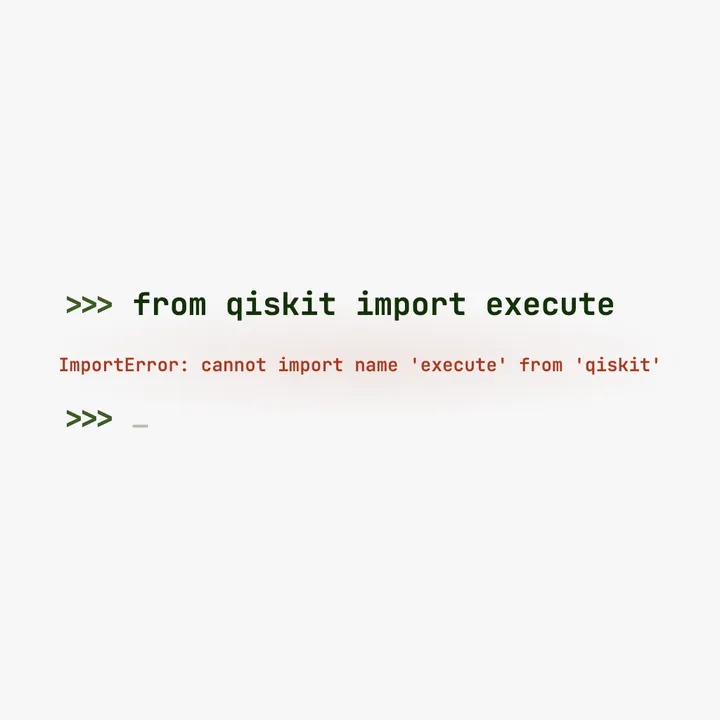
Run that on a current Qiskit and it does not warn you. It does not run a little slower. It dies on the first line:
ImportError: cannot import name 'execute' from 'qiskit'
That function was removed. The AI does not know, because nothing told it, and it will often defend the code if you push back. The modern way uses a different object, a primitive called a sampler, and if I had trusted the model instead of running its code I would have spent an evening confused about why a supposedly correct example refused to start.
The version trap is only the loudest case. The same confidence shows up on plain arithmetic and on matrices, where it is harder to catch because there is no error message, just a wrong number that looks plausible. Ask it to multiply two matrices by hand and it will often produce something that is the right shape, mostly right, and quietly wrong in one entry. Ask it for a gate and you might get a real gate with a sign flipped. None of this comes with a warning label. It reads exactly like the correct answer, which is the entire problem. A wrong import at least crashes. A wrong sign just sits there and corrupts everything you build on top of it.
So the rule for anything technical is blunt. Run it. The interpreter is the honest one in the room. If the code runs and gives the answer you expected, good. If it does not, you just caught the lie in seconds, for free, and you go check the official documentation for the real way to do it. Never let an AI be your single source of technical truth. Math, you confirm by hand or in NumPy. Code, you confirm by running it and reading the docs. The AI proposes. The machine disposes.
The prompts that actually teach
Most people use AI like a vending machine. Insert question, receive answer, walk away having learned nothing. The answer was the least valuable thing you could have asked for. Here are the five ways I prompt instead, each one designed to leave understanding behind rather than just a result. I will use quantum examples, but every one of these works for anything hard.
Explain, then quiz me. Not just "explain superposition." Instead: "Explain superposition to an absolute beginner, then ask me three questions to check whether I actually got it." Now the tool builds the explanation and immediately turns it into a test. You find your gaps in the same breath you fill them. The questions are the valuable half. A good one will not just ask you to repeat the definition, it will ask you to apply it to a case you have not seen, and that is exactly where a shaky understanding falls over. If I breeze through the recall but stumble on the third applied question, I have learned something precise about what I do not yet have, and I can aim my next round straight at it instead of vaguely rereading the whole topic.
Find my mistake. This is worth ten times more than asking for the answer. "Here is my reasoning for why this gate is unitary, and here is my NumPy code. Where am I wrong?" You did the work, you exposed your thinking, and the AI does the one thing it is genuinely excellent at, spotting the flaw in something concrete that is sitting in front of it. You keep the muscle. It just corrects your form.
Make me a graded set. "Give me five exercises on the tensor product, increasing in difficulty, then check my solutions one by one." This turns a passive topic into active reps, and reps are where the learning lives. The grading at the end closes the loop so you are not quietly practising the same mistake five times.
Three different analogies. "Give me three different analogies for relative phase." One analogy can mislead you. Three, side by side, triangulate the real idea, and the places where the analogies disagree are usually where the truth actually lives. This one is pure intuition fuel.
Let me teach it. "I am going to explain entanglement to you. Correct me wherever I am wrong." This is the Feynman technique with a patient, tireless partner. The act of teaching forces you to find the order, the words, the joints of the idea. Where you fumble, you have found a gap, and you have a tutor right there to patch it. This is the single highest return prompt I use.
Here is what that looks like in practice, lightly cleaned up from a real session. I told it: "A Hadamard puts a qubit into superposition, so applying it twice puts it into even more superposition." That feels reasonable. It is also wrong, and the tutor caught it cleanly. Two Hadamards in a row cancel out and return the qubit to where it started, because the gate undoes itself. I had a tidy, confident, false belief, and saying it out loud to something that could correct me dragged it into the light in one move. I would never have caught it by rereading, because rereading the correct explanation does not surface my incorrect version of it. Only producing my version does. That is the whole power of teaching it back.
Notice what every one of these has in common. The work stays with you. The AI is a mirror, a sparring partner, an examiner. It is never the thing doing the understanding on your behalf.
What I never ask it to do
The flip side of the good prompts is a short list of things I refuse to hand over, because handing them over is how the tool quietly hollows out your learning.
I never ask it to do my recall for me. The point of closing the tab and rebuilding an idea from memory is that the effort is mine. If I get stuck and immediately ask the AI to finish the thought, I have skipped the exact rep that would have built the understanding. The stall is the workout. Outsourcing it defeats the purpose.
I never ask it whether I understand something. It cannot know, and it is far too agreeable to be trusted with the question. Ask "do I get this?" and you will usually get encouragement, because that is the path of least resistance for a model trained to be helpful. The only honest test of whether I understand something is whether I can produce it or use it myself. That is a test I run, not a verdict I request.
And I never paste its unverified math or code straight into something I am building on. Anything technical gets run or checked first. A proposed answer is a draft, not a fact, and I treat the gap between those two as sacred. The moment I forget it, the tool stops being a tutor and becomes a very persuasive source of bugs.
The one rule under all of it
If you strip everything above down to a sentence, it is this. The AI is a tutor, not an authority.
A good tutor explains things well, asks you hard questions, catches your mistakes, and never minds repeating themselves. You still do the learning. You still check the facts that matter, because a tutor can be wrong, and this particular tutor is wrong with a remarkably steady voice. The instant you promote it from tutor to oracle, you have handed your understanding to something that cannot tell you when it is making things up.
The trust is earned by the verification, not assumed in spite of its absence. That is not cynicism. That is just how you work safely with a powerful tool that does not know its own limits.
One honest caveat
An AI tutor is a tool, and a tool is not company. The hardest part of learning something difficult on your own is not the difficulty, it is the isolation. A model on call at midnight helps enormously with the difficulty and not at all with the isolation. So I use it for what it is good at, and I still go find real people, the forums, the communities, the places where humans who actually build this stuff hang out. The AI accelerates the learning. It does not replace the company. Do not let it quietly convince you that it is enough on its own.
Why this bites harder in quantum
Everything above is true for learning anything. It is just sharper here, for two reasons worth naming.
The first is that quantum is genuinely unintuitive. With a popular web framework, a wrong mental model gets corrected fast, because the thing visibly does not work and a thousand tutorials nudge you back on track. Quantum has fewer of those guardrails, and the subject actively fights your intuition. So a confident wrong explanation does more damage, because you have less of your own instinct to flag it, and the illusion of understanding can ride along unchallenged for weeks. The recall habit is not a nicety here. It is the main thing standing between you and a tidy collection of misconceptions.
The second is that the material online is thinner and changes faster. There is far more correct, recent, well ranked content about building a website than about running a circuit on this year's Qiskit. That means more of what the model absorbed is old or sparse, which is exactly the soil hallucinations grow in. The version trap from earlier is not a fluke. It is the predictable result of a fast moving, lightly documented field meeting a model trained mostly on the past.
Put those together and the conclusion is not use AI less. It is verify more, here, than you would anywhere else. The upside of a tutor is even bigger in a hard, sparse field, because there is less else to lean on. So is the cost of trusting it blindly. The discipline scales with both.
The thing behind the thing
I spend my days putting AI inside systems and making those systems reliable. The lesson there is the same one as here. A powerful component is only as good as the checks around it. You do not refuse to use it because it can fail. You build it in, and you build the verification in right alongside it, and the whole thing becomes trustworthy precisely because you never trusted any single piece blindly.
My quantum tutor never sleeps, never sighs, and never runs out of patience for my fifth version of the same question. It is also wrong sometimes, with a perfectly straight face. Both true. I get the entire upside of the first by never forgetting the second. The tab closes, the page stays blank until I can fill it myself, and the code has to run. That is the whole trick.