A qubit is not a coin under a cup
The superposition myth, taken apart with math you can run. Not a hidden answer waiting to be read, but something stranger and far more precise.

There is one sentence everyone uses to explain a qubit. A qubit is both 0 and 1 at the same time. I read it a hundred times before I started learning this properly. It sounds deep. It sounds like the door to something strange and powerful.
It is also the sentence that held me back the longest.
I build automation pipelines, and the real skill in that is holding precise mental models of systems. If I do not know exactly what a node does to the data passing through it, the whole pipeline is a guess that happens to work until it does not. So when I started quantum and the very first idea arrived wrapped in a sentence that falls apart the moment you poke it, I did the thing I always do. I stopped and asked what is actually happening here.
This is what I found. And once it clicked, half of quantum stopped being mysterious and started being mechanical.
The sentence that explains nothing
"Both 0 and 1 at the same time" does no work. Ask the obvious follow up and it collapses.
If the qubit is already both, why do I only ever read one value out of it? And if it is secretly 0 or 1 and I just do not know which yet, then it is not special at all. It is a coin under a cup. Decided, hidden, boring.
That second reading is the trap, and almost everyone quietly falls into it. They picture a qubit as a coin spinning in the dark, already landed, waiting for you to lift the cup and look. It feels like the safe, grown up version of the slogan. It is also wrong, and it is wrong in a way you can prove with ten lines of code.
A qubit in superposition is not a hidden answer. It is not a coin that has already decided. It is a genuinely different kind of object, and the difference shows up the moment you do something a coin cannot survive.
What it actually is
Go back to the math, because the math is honest where the words are slippery.
A qubit is a vector of two complex numbers.
|ψ⟩ = α|0⟩ + β|1⟩
|0⟩ and |1⟩ are just names for the two definite answers, and |ψ⟩ is the qubit's state. α and β are called amplitudes. They are complex numbers, and the first thing to burn into your head is that they are not probabilities. To get a probability you take the size of an amplitude and square it. That is the Born rule:
P(0) = |α|² and P(1) = |β|²
The two probabilities have to add up to one, so |α|² + |β|² = 1. That single equation is the only rule the amplitudes have to obey.
Superposition just means both α and β are nonzero. The qubit is not sitting on 0 or on 1. It is a specific blend of the two, described by those two numbers. And here is the part the coin story cannot account for. You can change the amplitudes, get a completely different qubit, and the probabilities stay exactly the same. Hold onto that. It is where the coin dies.
For the record, the equal blend has a proper name. Physicists call it |+⟩, and its mirror image, the one with a minus sign between the two halves, which you will meet a few lines down, is |−⟩. Two states, identical fifty fifty probabilities, and yet completely different objects. If amplitudes were just probabilities wearing a costume, |+⟩ and |−⟩ would be the same state. They are not, and the rest of this post is really one long demonstration of why that gap is the whole point.
The test that breaks the myth
Here is the experiment. Take a qubit that starts in plain 0. Apply a Hadamard gate, the gate whose entire job is to build a superposition. You get an equal blend.
H|0⟩ = (|0⟩ + |1⟩) / √2
Square the amplitudes and both come out to one half. Fifty fifty. So far the coin story survives just fine. Measure now and you get 0 or 1, half the time each. A coin under a cup would hand you the same numbers.
Now do not measure. Apply a second Hadamard instead.
Think about what the coin story predicts. If the qubit were really a coin that had already secretly landed on 0 or 1, then a second shuffle is just shuffling a coin that is already decided. You stay at fifty fifty. There is no sequence of honest shuffles that takes a coin which is already heads or tails and turns it back into guaranteed heads.
The qubit does exactly that.
A second Hadamard on the equal blend gives you back plain 0. Not fifty fifty. Certain. Every single shot.
import numpy as np

ket0 = np.array([1, 0])
H = (1/np.sqrt(2)) * np.array([[1,  1],
                               [1, -1]])

once  = H @ ket0          # equal blend  -> [0.707, 0.707]
twice = H @ once          # back to |0>  -> [1, 0]

print(np.abs(once)**2)    # [0.5 0.5]
print(np.round(np.abs(twice)**2, 12))   # [1.  0.]
Run it. After one Hadamard the probabilities are [0.5, 0.5]. After two they are [1, 0]. The qubit walked into a fifty fifty blend and walked back out to a guaranteed zero, with no measurement anywhere in between.
A coin cannot do this. A probability cannot do this. Something else is going on, and it has a name.
The something else is called interference
Look at what the second Hadamard is doing under the hood, by hand, because it is only one line of arithmetic and it is the whole point.
The blend is (|0⟩ + |1⟩)/√2. Push each piece through the gate. The gate sends |0⟩ to (|0⟩ + |1⟩)/√2 and it sends |1⟩ to (|0⟩ − |1⟩)/√2. Add them up, each carrying the 1/√2 from the blend:
(|0⟩ + |1⟩)/2 plus (|0⟩ − |1⟩)/2
The |0⟩ parts line up and add to a full |0⟩. The |1⟩ parts have opposite signs and cancel to nothing. What survives is plain |0⟩.
That cancellation is the entire story. It is called interference, and it is only possible because amplitudes are not probabilities. Probabilities are never negative. You cannot have minus thirty percent chance of rain. Amplitudes can be negative, they can be complex, and when two of them meet with opposite signs they wipe each other out.
You can see that negative sign in the open. Run a Hadamard on a 1 instead of a 0:
H|1⟩ = (|0⟩ − |1⟩) / √2
Same probabilities as before, one half each. But that minus sign is a real, physical difference between this state and the plus version. The probabilities cannot see it. The next gate can. That hidden sign is what physicists call relative phase, and it is exactly the thing a coin does not have.
So a qubit carries more than its measurement outcomes let on. It carries the amplitudes, signs and all. Measurement throws nearly all of that away and hands you a single bit. Everything clever in quantum computing happens before measurement, in the part of the state the coin story cannot even describe.
The myth that does the real damage
There is a worse version of the slogan, and it is the one that wrecks people coming from software. It goes like this. A quantum computer tries every possible answer at the same time. Put fifty qubits in superposition and you are secretly running over a million billion calculations in parallel, for free.
If that were literally true and usable, quantum computing would be trivial. You would set up the superposition, run your function, and read off the right answer. Done. Infinite parallel processors in a box.
You cannot. And the reason you cannot is the most important thing on this page.
Yes, all those possibilities are present in the amplitudes at once. No, you do not get to read them. Measurement does not return the whole table. It returns one row, picked at random, with odds set by the squared amplitudes. Look once, get one outcome, and the rest is gone.
Here is the version that landed for me as a builder. Picture a hash table with a million keys. Superposition lets you write to every key in a single step, all at once, which sounds like a superpower. The catch is the read. You are allowed exactly one read, it returns a random key, and the act of reading wipes the table. Write to a million in parallel. Read exactly one, at random. Lose the rest. Said that way, the parallelism stops being a free lunch and becomes a hard constraint you have to engineer around.
So the parallelism is real but locked. The entire game of quantum algorithm design is figuring out how to use interference to make the one outcome you are allowed to read be the one you actually want. You arrange for the amplitudes of the wrong answers to cancel and the amplitudes of the right answer to add up, before you measure. That is hard. That is why there are only a handful of quantum algorithms and not a thousand. "Tries everything at once" hides all of that difficulty behind a phrase that sounds like a free lunch. There is no free lunch. There is choreography.
A blend is still a definite state
One more correction, because this one caught me too. People say a superposition is uncertain. It is not.
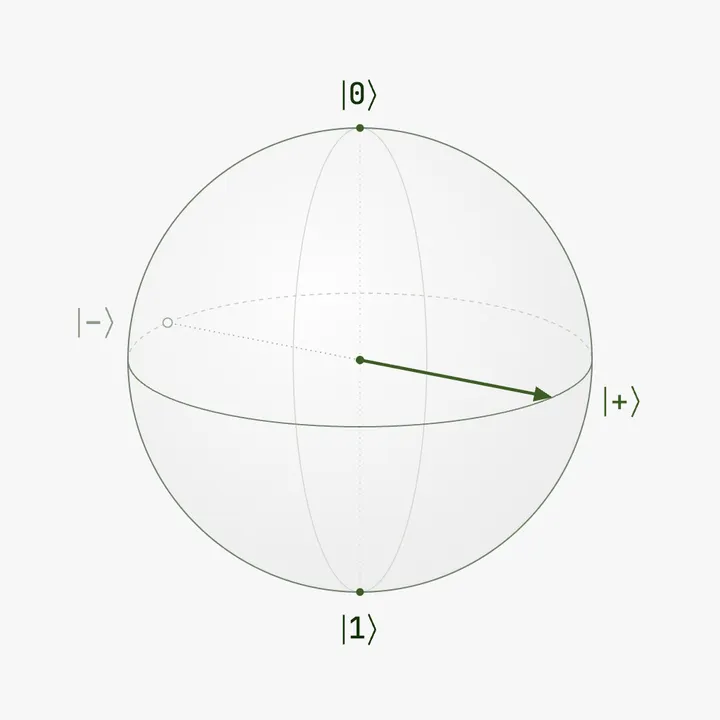
(|0⟩ + |1⟩)/√2 is a perfectly definite state. It has a name and an address. It is what you get by rotating 0 by ninety degrees on the sphere I describe in the next section, and there is a measurement for which it gives a single, certain answer every time, the one you get by applying a Hadamard first, the two Hadamard test above. It only looks uncertain because we keep measuring it in the 0 and 1 basis, where it happens to land fifty fifty.
The line that finally fixed this for me: superposition is not the qubit being unsure. It is the qubit pointing somewhere specific that does not happen to be one of the two labels we wrote on the axes. The uncertainty is a fact about the measurement we chose, not a fact about the qubit.
The builder's mental model
Here is how I hold it now, in terms I trust.
A qubit is a little arrow. Not on a number line, on a sphere. Gates are rotations of that arrow. Nothing random happens while the arrow turns. The evolution is exact, reversible, and as deterministic as any matrix multiply, because that is literally what it is, a matrix multiplying a vector.
Randomness enters at exactly one place. Measurement. That is the only step that takes the smooth arrow and forces it onto a 0 or a 1, with odds set by where the arrow was pointing. Up to that instant there is no coin and no dice. There is a state vector being transformed by a pipeline of exact operations.
If you come from software, that is the whole reframe. A qubit is not a probabilistic bit. It is a vector you push through a sequence of exact transformations, and the only stochastic event in the entire program is the read at the end. The "both at once" language is gesturing at the fact that the vector has two nonzero components. It is not describing a coin, and treating it like one will mislead you on every algorithm that comes later.
If you want to watch the arrow instead of trust me, Qiskit will show you the state directly, no measurement involved:
import numpy as np
from qiskit import QuantumCircuit
from qiskit.quantum_info import Statevector

qc = QuantumCircuit(1)
qc.h(0)                                    # one Hadamard: equal blend
print(np.round(Statevector(qc).data, 3))   # [0.707+0.j 0.707+0.j]

qc.h(0)                                    # second Hadamard: interference
print(np.round(Statevector(qc).data, 3))   # [1.+0.j 0.+0.j]  -> back to |0>
Same result as the NumPy version, because it is the same math. The state vector is the truth. The probabilities are just what is left after you look.
Why this matters, without the hype
I will be blunt, because the hype around this is exhausting.
Superposition on its own is not the reason quantum computers are interesting. A single qubit in a blend is not doing anything a clever classical trick cannot imitate. The power only shows up when you put many qubits in superposition together, entangle them, let their amplitudes interfere on purpose, and engineer the wrong answers to cancel while the right answer survives. That is what every real quantum algorithm is underneath. Grover, the Fourier transform, all of it. Choreographed interference.
So getting superposition right is not academic tidiness. If you keep the coin picture, every algorithm later looks like magic, because interference is invisible from inside that picture. Drop the coin, keep the amplitudes, and the algorithms turn into something you can actually follow. Still hard. But followable.
And superposition is only the first of two ingredients. The second is entanglement, where qubits stop having separate states of their own and only make sense together. Interference plus entanglement is where the real distance from classical computing opens up. But none of that is reachable while the first idea is still a coin in your head. So this is the floor. Get it solid and everything else has somewhere to stand.
That was the trade I did not see coming. I gave up a comfortable one sentence explanation and got back a mechanical one. For someone whose job is knowing exactly what each step does to the data, that was the better deal by a mile.
Where I am learning this
All free, all worth your evening. 3Blue1Brown for seeing the vectors and the rotations instead of just reading the symbols. Khan Academy when I need to repair the algebra underneath. And for quantum specifically, running it myself in Qiskit, because nothing kills a wrong mental model faster than watching the real thing disagree with you on screen.
I am keeping the whole map in one place as I go, in my own study notes, every concept and the order I ran into it. This was one of the earliest, and one of the most important to get right, because everything else is built on top of it.
How to check whether you actually get this
Reading this and nodding along is not the same as understanding it. I learned that the hard way, so here is the test I run on myself, lifted straight out of my own study notes.
Close this tab and answer three things out loud, in your own words. Out loud matters. The moment you have to make a mouth say it, you find out fast whether it is real.
One. Why is a qubit in superposition not the same as a coin under a cup? If your answer does not reach for the word interference, or the fact that amplitudes can be negative, you have not got it yet. You have got the slogan back.
Two. After two Hadamards in a row you get a guaranteed 0. So where did the 1 go? The honest answer is not "it became unlikely". It is "its amplitude cancelled against itself". Make sure you can say why, with the two pieces and the opposite signs.
Three. A quantum computer holds every answer in its amplitudes at once. Why can you not just read them all and skip the hard part? If you cannot explain the one read, one random outcome limit, then quantum algorithms are going to keep looking like a magic trick instead of a design problem.
If any of the three made you stall, that stall is the gold. It is the exact spot where your understanding is thin, and it is worth ten times more than rereading the parts you already knew. Most people do the opposite. They reread what feels comfortable and skip the part that made them stop. Go back to just the part that made you stop.
And if you want the fastest way to make all three stick, do not take my word for any of it. Open Python, type out the two Hadamard example from earlier, change one number, and watch what breaks. A wrong mental model does not survive contact with code that runs. That, more than any explanation, is what moved this from "sounds right" to "I know this" for me.
The thing behind the thing
My day job is the system nobody sees that makes the visible part work. Quantum keeps turning out to be the same shape. There is the slogan on top, the one everyone repeats at parties. Under it, the actual mechanism, quieter and stranger and far more precise than the slogan lets on.
A qubit is not a coin under a cup. It is a vector with two amplitudes, turning under exact rotations, uncertain about nothing, until the single moment you force it to choose.
That is not a smaller idea than the slogan. It is a much bigger one. It just does not fit on a bumper sticker.