The Python you actually need for quantum computing
Dictionaries for counts, just enough OOP to read Qiskit, and NumPy as the bridge. The thin slice that matters, nothing else.

I have written code almost every day for years. n8n flows, Python glue, the automations that quietly run a business while everyone sleeps. So when I started quantum and people kept handing me "learn Python first" guides that open with what a variable is, I closed every one of them. I did not need to learn to program. I needed to find out which parts of a language I already speak actually turn into quantum, and which parts I could keep ignoring.
That turned out to be a much shorter list than I expected. The math had gone the same way. You do not relearn the whole thing. You learn the thin slice that quantum leans on, and you leave the rest exactly where it is.
Here is that slice, and the pieces that genuinely surprised me along the way.
You are not learning to program. You are learning what maps.
If you have never written code, ignore this post and go do a proper beginner course first. I will link a good one at the end. But if you already build things, the framing that wasted the least of my time was this. Do not ask what Python can do. Ask which Python concepts become quantum concepts the moment you cross over.
There are only a handful. A dictionary becomes your measurement result. Method chaining becomes how you read a result. Classes and objects become the reason qc.h(0) is not gibberish. And NumPy becomes the place where you can actually do quantum by hand, with no quantum library at all. Get those four and you can read and run real Qiskit. Everything else is comfort you already have, or comfort you do not need yet.
The dictionary is your quantum result
Start with the one that surprised me by how directly it carried over.
A dictionary in Python holds pairs of key and value, inside curly braces. You look things up by key, not by position. If you have ever moved data between n8n nodes, you already know this object intimately. It is the JSON that flows down the pipe.
counts = {"00": 512, "11": 488}     # a typical quantum result
print(counts["00"])                 # 512
print(counts.get("01", 0))          # 0, and it does not crash on a missing key
for state, n in counts.items():     # walk every outcome
    print(state, n)
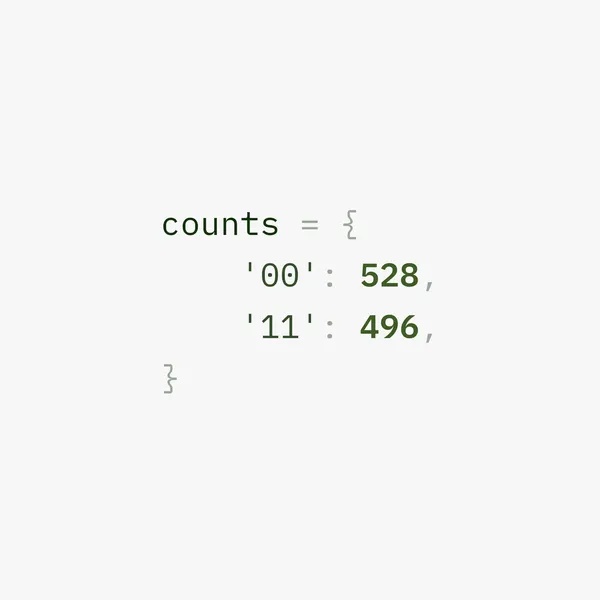
Here is why I am starting here. When you run a circuit and measure, Qiskit hands you exactly this. A dictionary. The key is the bit string you measured, "00" or "11" or "01". The value is how many times it came up across your shots. Reading a quantum result is reading a dictionary. The two methods you will use constantly are .get, because it does not blow up when an outcome never occurred, and .items, because that is how you loop over the whole thing to print it or plot it.
So the very first quantum skill is a dictionary skill you may already have. That set the tone for the entire language. Less new than it looked.
The everyday glue: lists and loops
Two more pieces you already use without thinking. They do not become anything quantum, which is why they are not part of the four. A list is just an ordered run of values in square brackets. A for loop walks through a collection one item at a time. Between them, they are how you do anything to a result rather than just look at it.
counts = {"00": 512, "11": 488}

total = sum(counts.values())          # 1000 shots in all
top   = max(counts, key=counts.get)   # '00', the most frequent outcome

for state, n in counts.items():       # turn raw counts into fractions
    print(state, round(n / total, 3)) # 00 0.512   then   11 0.488
Run it. You summed the shots, found the outcome that came up most, and converted the whole result into the rough probabilities it stands for, all with a loop and a couple of built in functions. This is the kind of small handling you do constantly once results start coming back, and none of it is special to quantum. It is the same listing and looping you would do to any pile of data. If you build things already, this is muscle memory, not new ground.
That is the honest shape of it. Lists and loops to handle results, a dictionary to hold them, chaining to read them, objects to build the circuit, and NumPy to check the whole thing by hand.
Reading chained code, or why the first Qiskit line looks like noise
This is a reading skill, not a writing skill, and it is the one that unlocks the most. Without it, the first line of results you see from Qiskit looks like someone fell on the keyboard.
The rule is singular. You read left to right. Each piece produces an object, and the next piece acts on that object. A dot means take something from. Parentheses mean call it. Square brackets mean take the element at that index.
" Hello World ".strip().lower().split() # ['hello', 'world']
Read it like a conveyor belt. The string goes in. .strip() removes the outer spaces and passes "Hello World" along. .lower() lowercases it and passes "hello world" along. .split() breaks it on spaces and hands you the list. Each step takes the result of the step before. If you ever lose track, stop the belt anywhere and look. " Hello World ".strip() on its own shows you the intermediate value.
Indexing chains the same way. Square brackets just take an element, and you can keep going:
counts = {"00": 512, "11": 488}
list(counts.items())[0]      # ('00', 512)   the first key value pair
list(counts.items())[0][1]   # 512           the second item of that pair
The first [0] picks the first pair out of the list. The second [1] reaches into that pair and takes the value. Brackets stack onto each other exactly like dots do. Same conveyor belt, same habit of stopping wherever you get lost.
Now the line that scares everyone on their first real hardware run:
counts = job.result()[0].data.c.get_counts()
It looks horrible. It is the exact same conveyor belt. job.result() gives you a results object. [0] takes the first result, because you can submit several circuits at once. .data reaches into its data. .c is the classical register where your measurement landed, named c by default when you declare it yourself, or meas if you used measure_all. .get_counts() turns it into the counts dictionary from the section above. Nothing mysterious. A chain you read one link at a time.
Once that clicked, half of Qiskit stopped being intimidating. It is not a new language. It is method chaining, which Python has always had.
Objects and methods: qc.h(0) is not magic
You need just enough object oriented Python to read a circuit, and not a drop more. Here is the entire amount.
A class is a blueprint. An object is a thing built from that blueprint. A method is something the object can do. You build the object once, then you call methods on it to change it.
class Counter:
    def __init__(self, start=0):   # runs when you build the object
        self.value = start         # an attribute lives on the object
    def bump(self):                # a method
        self.value += 1

c = Counter()    # build one
c.bump()
c.bump()
print(c.value)   # 2
That is genuinely all the theory you need. And here is the payoff, the moment it stops being abstract:
from qiskit import QuantumCircuit

qc = QuantumCircuit(2)   # build an object from the QuantumCircuit blueprint
qc.h(0)                  # call the Hadamard method on qubit 0
qc.cx(0, 1)              # call the CNOT method
QuantumCircuit is the class. qc is your object. .h(0) and .cx(0,1) are methods you call on it to add gates, a Hadamard on qubit 0 and a CNOT, the two qubit gate that flips qubit 1 whenever qubit 0 is 1. Without this picture, that code looks like an incantation. With it, it is the most ordinary thing in the world. You made an object and you are calling methods on it, exactly like the counter.
NumPy is the actual bridge
This is the piece that changed how I learn quantum, full stop. NumPy is where you can do quantum by hand, on a normal computer, with no quantum library involved. A qubit is a vector. A gate is a matrix. NumPy does vectors and matrices. So NumPy can run a quantum gate, and you get to watch the numbers move.
Keep this block somewhere you can reach it. It is the bridge between the formulas and code that runs.
import numpy as np
s = 1/np.sqrt(2)

I = np.array([[1, 0], [0, 1]])      # identity, does nothing
X = np.array([[0, 1], [1, 0]])      # quantum NOT: |0> <-> |1>
Y = np.array([[0, -1j], [1j, 0]])   # Pauli Y, note the imaginaries
Z = np.array([[1, 0], [0, -1]])     # flips the sign of |1>
H = s * np.array([[1, 1], [1, -1]]) # Hadamard, builds superposition

ket0 = np.array([1, 0])             # |0>
ket1 = np.array([0, 1])             # |1>

print(X @ ket0)              # [0 1]          NOT flipped the bit
print(np.round(H @ ket0, 3)) # [0.707 0.707]  an equal superposition
Run it. The @ symbol is matrix multiplication, which is the literal act of applying a gate. X @ ket0 flips a 0 into a 1. H @ ket0 builds the superposition you read about everywhere. You are doing quantum, and it is just NumPy.
And the payoff, the moment the bridge actually carries something. Turn those amplitudes into the probabilities you would measure, with one more line:
psi = H @ ket0          # [0.707, 0.707], an equal superposition
print(np.abs(psi)**2)   # [0.5 0.5], the odds of measuring 0 or 1
That np.abs(psi)**2 is the Born rule, the rule that converts amplitudes into measurement odds, and here it is as a single NumPy call. You built a state and read off its probabilities, by hand, before touching a single quantum library. That is the whole reason NumPy is the bridge. Everything Qiskit does to a small circuit, you can reproduce here and check against it.
Three small operations carry almost all the weight, and they are worth memorising. np.abs(psi)**2 turns amplitudes into probabilities, which is the Born rule in code. A.conj().T is the dagger, written A† in the books, the conjugate transpose that shows up everywhere in quantum. And np.linalg.norm(v) gives a vector's length, which for a valid quantum state must come out to 1.
One surprise to file away while you are here. The textbook writes the control qubit of a two qubit gate first. Qiskit numbers its qubits the other way around, so qubit 0 is the rightmost one. It is called little endian, and it will bite you the first time a matrix from Qiskit does not match the one on your page. Not wrong, just a different convention. Knowing it exists saves an evening of confusion.
assert is how you stop lying to yourself
Both of the quantum study files I work from shout the same thing at me. Verify everything in code. This is the tool that does it, and it is two lines.
assert says I am sure this is true. If it is true, nothing happens and the program carries on. If it is false, the program stops on the spot and tells you. It is a trap you set for your own mistakes.
The catch with decimals is that tiny rounding errors make exact equality lie to you. You get 0.9999999999 instead of 1.0, and a plain equality check says false for no good reason. So for anything numeric you ask np.allclose, which means equal up to a speck of dust.
import numpy as np
H = (1/np.sqrt(2)) * np.array([[1, 1], [1, -1]])

# A gate is valid only if it is unitary, meaning U dagger times U is the identity.
assert np.allclose(H.conj().T @ H, np.eye(2)), "H is not unitary"

# And a Hadamard applied twice should cancel: H times H is the identity.
assert np.allclose(H @ H, np.eye(2))

print("verified: H is unitary and undoes itself")
Run it. It passes in silence, which is the point. This is the habit that made my understanding stop wobbling. I stopped trusting that I had the matrix right because it looked right, and I started checking. When a gate I built fails the unitary test, I have a bug in my understanding, right there, in red, before it poisons anything downstream. For someone whose day job is pipelines that fail silently, this felt like home.
Seeing the result: counts to a histogram
One more small piece, because a quantum result is something you look at, not just print. The standard picture is a bar chart of the counts, and you can draw it with the plotting library Matplotlib in about three lines. There is nothing quantum here either. It is a bar per key, with the count as its height.
import matplotlib.pyplot as plt

counts = {"00": 512, "11": 488}     # the result you got back
plt.bar(counts.keys(), counts.values())
plt.xlabel("measured state")
plt.ylabel("count")
plt.show()
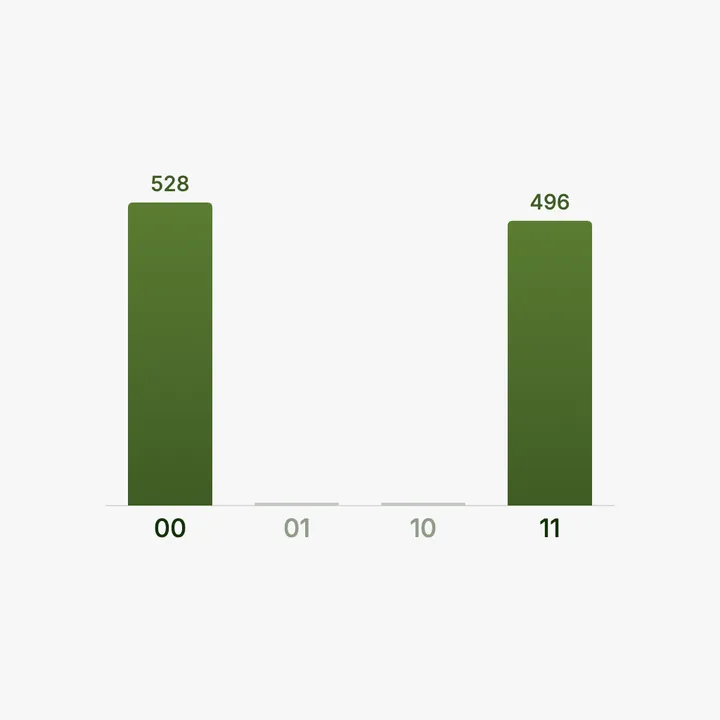
Run it and you get two bars, one for "00" and one for "11", roughly equal. That is the entanglement result everyone shows off, and you just plotted it from a plain dictionary. Qiskit ships its own prettier version called plot_histogram, but under the hood it is doing this, walking a counts dictionary and drawing a bar for each outcome. Once you have seen the three line version, the fancy one holds no mystery. It is the dictionary, drawn.
What I am deliberately ignoring
Just as useful as the list of what to learn is the list of what to skip, so you do not drown.
I am not touching decorators, generators as a craft, async, the bulk of the standard library, or the clever one line comprehensions people show off with. None of it pays off at the start. Comprehensions are nice, classes deeper than the counter above are not needed to read Qiskit, and the fancy stuff can wait for a version of me who does this full time. The integrals can wait too, same as with the math. The slice is small on purpose.
If you already build things, the honest summary is this. You are not learning Python. You are learning four small mappings and one habit. Dictionary is your result. Chaining is how you read a result. Objects and methods are why the gates make sense. NumPy is where you do it by hand. And assert is how you keep yourself honest.
A quick test before you move on
Close this and check yourself, out loud or on paper.
Can you read counts.get("01", 0) and say exactly what it returns and why it does not crash? Can you take the line job.result()[0].data.c.get_counts() and narrate it link by link? Can you build the Hadamard as a NumPy array, apply it to |0⟩, and get [0.707, 0.707]? And can you prove, with assert, that it is unitary?
If any of those made you hesitate, that is the piece to go back to. Not the parts that felt easy. The hesitation is the map to where your understanding is actually thin.
Where I am learning it
Free, as always. Python for Everybody by Charles Severance is the kindest on ramp if you are genuinely new, and it does not waste your time if you are not. The NumPy documentation has a quickstart that is short and exact. And for the bridge specifically, I just keep a single file of these blocks, the gates as arrays, the asserts, the chaining examples, and I add to it every time something surprises me.
The thing behind the thing
My job has always been the plumbing. The pipes nobody sees, carrying data from one place to another, that make the visible thing work. Quantum needed me to learn a few new pipes, that is all. A dictionary coming back from a measurement. A chain of methods reading a result. A matrix multiply that turns out to be a gate.
I did not have to become a programmer to learn quantum. I already was one. I just had to find the four pipes that connect to it, and ignore the rest of the hardware store.