IBM says I understand quantum machine learning now
Quantum kernels, variational classifiers, and the honest part: what it would take for quantum to beat classical machine learning, and why it has not yet.

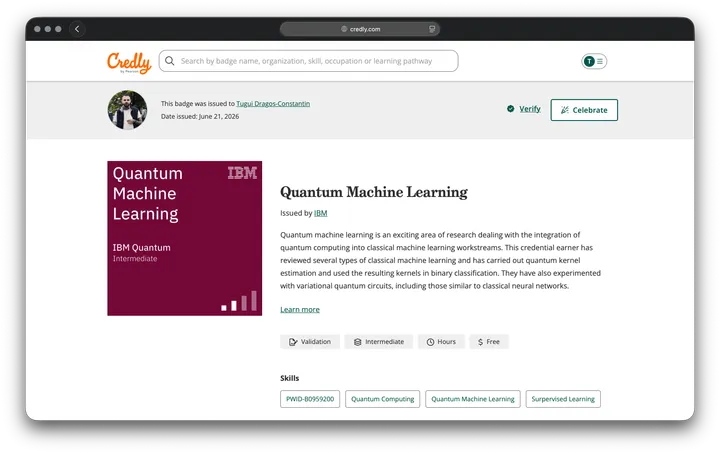
IBM just told me I understand quantum machine learning. That is what the badge attests to, and a badge attests to understanding, not to a result I produced on real hardware. I want to be precise about that from the first line, because the distinction is the whole point.
Concretely, the badge is a course followed by an exam: 20 questions, 80 percent to pass. Machine learning is the work I actually do, the systems I build and reason about every day. Quantum is the harder thing I have been learning in the open. This is the subject where the two meet, and I wanted to know exactly what that meeting looks like before claiming anything about it.
So here is what the badge actually puts in front of you, the thing that surprised me, and the part most people skip.
The badge trains you to say no, not just yes
The stated goal is to implement quantum kernel methods and variational classifiers with Qiskit primitives, adjust an example onto your own data, and then judge where quantum machine learning would actually help. That last part is the one I did not expect. The course spends as much effort on identifying where quantum machine learning is not promising as on where it is.
That is rare, and it is the most useful thing in the badge. Most material on this subject sells you the upside. This one hands you the limits in the same breath: training time, noise, and the compounding readout error, the chance a qubit is read as 1 when it was 0 or the other way round, you get when a model depends on measuring many states. It teaches the technique and the skepticism together. I came out able to argue against using quantum machine learning, which is worth more to me than being able to argue for it.
Two ways to put a qubit inside a machine learning problem
The course covers exactly two, and the difference between them is the whole map.
Quantum kernels. A support vector machine is a classical workhorse from the 1990s, and one of the expensive parts of training one is computing the kernel matrix, the table of how similar every data point is to every other. The kernel approach replaces that one calculation and nothing else. You encode each data point into a quantum state with a feature map, the circuit that turns a data point's numbers into angles on the qubits, and the kernel becomes the overlap between two of those states, |⟨φ(x)|φ(x′)⟩|². You estimate it by running the feature map for one point, the inverse for the other, and measuring how often you land back in the all zeros state. Fill the matrix, hand it to an ordinary classical support vector machine, and it draws the boundary exactly as it always has.
This is the part that made me stop. It is not a quantum computer doing machine learning. It is a quantum computer called in to compute one number, a similarity, inside a classical algorithm that stays otherwise untouched. The quantum contribution is narrow and exact. Naming it that plainly is most of understanding it.
Variational quantum classifiers. The second approach drops the classical model and trains the circuit itself. You build a parameterised circuit, define a loss, and let a classical optimiser turn the parameters in a loop until the circuit learns to separate the classes. In Qiskit Machine Learning, a separate package on top of Qiskit, this is the VQC, or a network built from EstimatorQNN or SamplerQNN. Stack the parameters in layers and the shape resembles a neural network closely enough that the comparison is fair. The loop itself is the same variational pattern that runs quantum chemistry. Only the target changed: the cost function is now a classification loss instead of an energy.
Most of it was machine learning I already knew
Here is what the badge reminded me more than taught me. Feature spaces, training and test splits, loss functions, overfitting, the kernel trick itself. All of it is classical machine learning, decades old, already familiar. Quantum machine learning does not reinvent the classifier. It changes how one quantity gets computed and leaves the rest of the discipline standing.
The quantum layer is thinner than the name suggests, and the hard part is still the machine learning. The one genuinely new judgment is the feature map. It is tempting to assume any encoding will do, and that more qubits means a better model. Neither is true. A bad feature map buys you nothing but a slower, noisier version of something a classical computer does better. An advantage requires an encoding that is hard to simulate classically, and even then it is not guaranteed. Understanding why most feature maps give you nothing was the real work.
The honest verdict
Quantum machine learning is a research area, and research is the right word. It is not a production tool. On today's noisy machines the practical advantage over classical methods is not established, the sample sizes are small, and there are open problems with training and scale that nobody has closed. I understood the techniques. I did not run them on real hardware here, and I am not going to suggest you can drop quantum machine learning into a working system tomorrow.
What it gives me is the thing I came for. The place where quantum computing meets the machine learning and automation work I already do is exactly where I want to stand by the end of the decade, and this is the first credential that lands squarely on it. The intersection is thin precisely because it is hard and unproven, which is the whole reason to be in it early.
I am not claiming quantum machine learning works yet. I am claiming I now understand it well enough to tell when it does.