Entanglement, explained without the spooky
The Bell state in two lines of code, what correlated really means, and why none of it sends messages faster than light.

Entanglement gets the full mystical treatment. Spooky action at a distance, the phrase Einstein used as an insult and the internet adopted as a slogan. Particles mysteriously linked across the galaxy. Telepathy, in the bad science fiction. It is presented as the strangest, least comprehensible thing in physics, the part where you are supposed to give up and just accept the magic.
It is a correlation. You can build one in two gates and measure it yourself this afternoon. There is something genuinely surprising at the bottom of it, and I will get to that honestly, but it is not what the marketing says, nothing crosses the gap that you could ever use, and it is definitely not telepathy. Here is what entanglement actually is.
The two line recipe
You make an entangled pair with two gates. A Hadamard on the first qubit, then a CNOT from the first to the second.
from qiskit import QuantumCircuit
from qiskit.quantum_info import Statevector
import numpy as np

qc = QuantumCircuit(2)
qc.h(0)         # qubit 0 into superposition
qc.cx(0, 1)     # CNOT: flip qubit 1 if qubit 0 is 1

print(np.round(Statevector(qc).data, 3))   # amplitude 0.707 on |00> and |11>, zero elsewhere
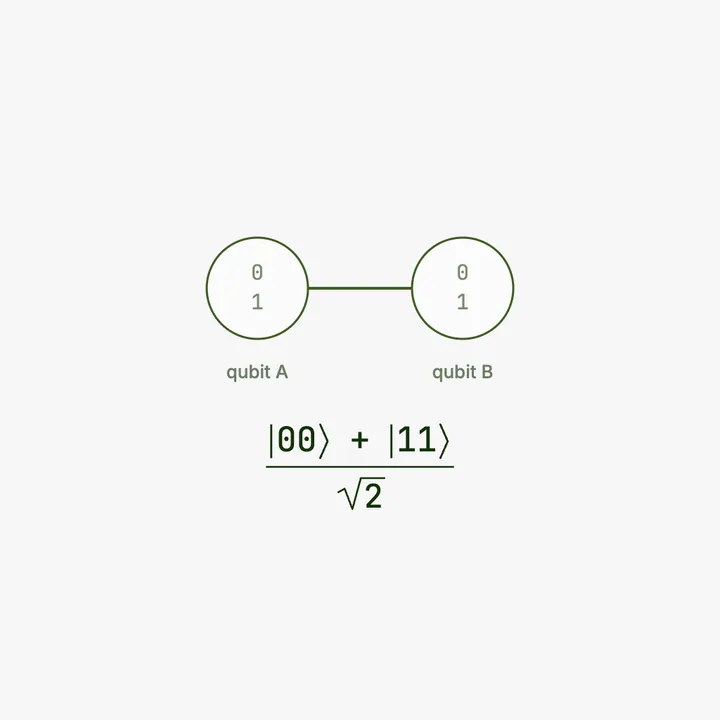
Run it. The state vector is [0.707, 0, 0, 0.707], and reading those four slots as the amplitudes on |00⟩, |01⟩, |10⟩, and |11⟩, that is (|00⟩ + |11⟩) divided by √2. That object has a name, the Bell state, and it is the simplest entangled state there is. Read what it says. There is an equal amplitude on |00⟩ and on |11⟩, and exactly zero amplitude on |01⟩ and |10⟩. The two qubits are in a superposition of both being 0 and both being 1, with nothing in between.
What it means when you measure
The amplitudes tell you the measurement story before you run it, by the same rule as always: square them and you have the probabilities. Equal weight on 00 and 11, none on the mixed outcomes. So if you measure both qubits, you should get 00 or 11, each about half the time, and never 01 or 10. Let us check.
from qiskit.primitives import StatevectorSampler

m = QuantumCircuit(2, 2)
m.h(0); m.cx(0, 1)
m.measure([0, 1], [0, 1])

counts = StatevectorSampler().run([m], shots=2000).result()[0].data.c.get_counts()
print(counts)   # {'00': ~1000, '11': ~1000}
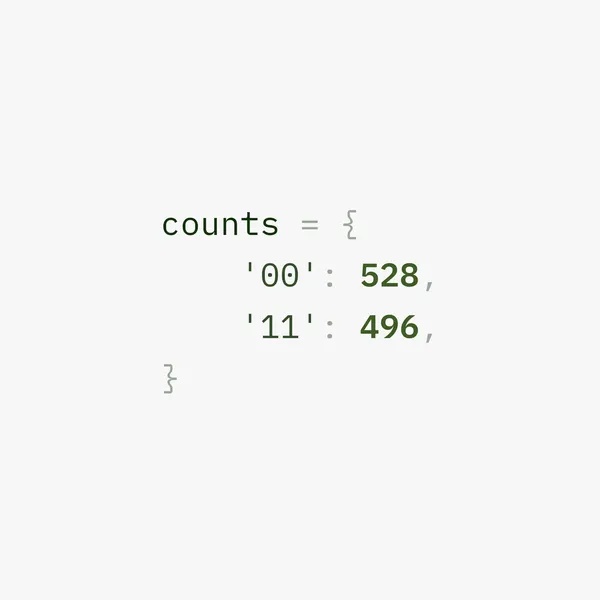
Run it. Only 00 and 11 come back, in a roughly even split, and the mixed outcomes never appear. The two qubits always agree. Measure one and find 0, the other is 0. Find 1, the other is 1. Every single time. That perfect agreement is the first thing the entangled state buys you. Be careful with it, though, because agreement in this one basis is a consequence of entanglement and not proof of it. A few sections from now I will describe something completely ordinary that produces the same table. What entanglement actually is needs a sharper definition than this, and that is what comes next.
The precise meaning: the whole is defined, the parts are not
Here is the definition that finally made it click for me, and it is sharper than spooky. A state is entangled when you cannot describe the two qubits separately. You cannot say qubit A is in this state and qubit B is in that state, and combine them. The only honest description is of the pair as a whole.
Contrast it with an unentangled pair. If qubit A is in some state and qubit B is in some state, independently, you build the joint state with the tensor product, the operation that glues two single qubits into one combined description, and you can always take it back apart into its two halves. That is a product state, and the parts have their own identities. The Bell state cannot be taken apart that way. There is no pair of single qubit states whose tensor product gives you (|00⟩ + |11⟩) over √2. Try to find one and you will fail, because it does not exist. The information is not in qubit A, and not in qubit B. It is in the relationship between them, and nowhere else.
Each qubit alone looks like pure noise
This is the part that makes it concrete. If you ignore one qubit of the pair and look only at the other, what do you see? Pure randomness. Fifty fifty, no structure at all.
from qiskit.quantum_info import partial_trace
sv = Statevector(qc)
reduced = partial_trace(sv, [1])    # throw away qubit 1, look at qubit 0 alone
print(np.round(np.real(reduced.data.diagonal()), 3))   # [0.5 0.5]
Run it. What comes back is the description of one qubit on its own, with the other discarded, and the name for that is the marginal. It is a density matrix rather than a state vector, which is precisely because half an entangled pair has no state vector of its own to give you. Its diagonal holds the probabilities, and here they are fifty fifty. Qubit 0, on its own, is a perfect coin. So is qubit 1. Neither qubit carries any information by itself. All of it lives in the correlation, in the fact that whatever the coins do, they do it together. This is exactly why you cannot read anything out of one half of an entangled pair. There is nothing there to read. The structure only appears when you bring the two measurements together and compare.
Why this is not faster than light communication
Now to kill the science fiction, carefully, because it is a fair question. The tempting way to put it is that measuring qubit A here instantly determines what qubit B will give over there, however far apart they are. Does that not send a signal faster than light?
No, and the reason is in the randomness you just saw. When you measure your half, you get a random result, 0 or 1, fifty fifty. You do not get to choose it. So you cannot encode a message in it, because you have no control over what comes out. The person holding the other qubit also sees a random bit. The two random bits happen to match, but neither person can tell, from their side alone, that anything special occurred. Their qubit just looks like a coin flip, exactly as the marginal showed. The only way to discover the correlation is for the two of you to get together and compare your lists of results, and that comparison travels over an ordinary channel, a phone call, an email, something no faster than light. No usable information crosses the gap at the moment of measurement. Nothing you could ever signal with. The correlation is real and the communication is not, and holding those two facts together is the whole trick. The word instantly is also doing more work than it can carry. For two measurements far enough apart, which one happened first depends on who is watching, and there is a frame of reference in which the other one went first. Nothing about the correlation changes. That is another way of seeing that no signal is passing between them.
"But that is just two sealed envelopes"
A sharp objection turns up here, and it is worth taking seriously because answering it is what reveals the real content. You might say: this is nothing special. Flip a coin, put a card of the same colour, red or blue, into each of two envelopes, and mail them to two cities. Whoever opens theirs instantly knows the other's colour. Perfect correlation, no magic, no physics, and certainly no faster than light anything. Is an entangled pair not just a fancy version of that?
For the simple measurement above, you are almost right, and that is the honest part most explanations skip. If all you ever do is measure both qubits the same way, the Bell state behaves exactly like two sealed envelopes. The correlation you see could be explained by the qubits having agreed on their answers at creation, like the cards chosen before mailing. Nothing you have seen so far rules that out. This is why I keep insisting entanglement is a correlation and not telepathy: at this level of looking, the envelope story fits.
The envelopes break only when you start measuring the two qubits in different, cleverly chosen ways and compare the statistics across many runs. That is where the quantum correlations climb past anything sealed envelopes could ever produce, and it is exactly the experiment the next section describes. So hold the envelope picture as your baseline, because it is correct as far as it goes, and watch what it cannot reach.
So what is actually surprising
I promised honesty, so here it is. The genuinely strange part is not the speed. It is the strength of the correlation. You might think the qubits simply agreed on an answer in advance, like two people who synchronised their watches before leaving, so of course they match later, no magic needed. For decades that was the natural sceptical position: maybe each qubit secretly carries a hidden instruction set, decided at creation, and measurement just reads it out.
It turns out you can test that idea, and it fails. There is a class of experiments, Bell tests, that measure entangled pairs in cleverly chosen ways and count how often the results agree. Suppose each qubit carries its own instruction set, fixed at creation, and answers from it alone, untouched by whatever happens to its partner far away. That assumption puts a hard ceiling on how correlated the two can be. Quantum mechanics predicts correlations above the ceiling, and the experiments, run many times by many groups over decades, see the quantum number, not the ceiling. So the watch synchronising story is dead. There is no local hidden instruction set, and the correlation is stronger than any advance agreement of that kind could produce.
Be careful about what that settles, because this is where popular explanations reach for the mysticism again. The experiments rule out local instruction sets. They do not tell you what to put in their place, and physicists who agree perfectly on every number still disagree about that: some give up locality, some give up the idea that the answers existed before anyone looked, some reject the question's framing entirely. Those arguments are live, not settled, and this post is not going to resolve them. What is settled is the measurement, and the measurement is enough. A correlation that no advance agreement can account for, verified in laboratories for decades, is far more interesting than telepathy.
It scales: three qubits, all agreeing
Entanglement is not a two qubit party trick. You can entangle three, or thirty. Add one more CNOT to the recipe and you get a three qubit state where all three agree.
ghz = QuantumCircuit(3)
ghz.h(0); ghz.cx(0, 1); ghz.cx(1, 2)
print(np.round(Statevector(ghz).data, 3))   # weight only on |000> and |111>
Run it. The state is (|000⟩ + |111⟩) over √2, with zero amplitude on all six mixed outcomes. This one has a name too, the GHZ state, and measuring it gives 000 or 111, never anything in between. All three qubits agree, every time, the two qubit story extended. These larger entangled states are workhorses in error correction and in the protocols that need many qubits locked together, and the recipe stayed almost the same: a Hadamard to start the superposition, then CNOTs to spread the agreement down the line.
There is more than one Bell state
A small thing that tidied up my mental model: the pair you build is not the only entangled two qubit state. There is a whole continuum of them, and sitting inside that continuum is the set everybody actually uses, the four Bell states. They are mutually orthogonal, they are maximally entangled, and together they form a complete basis for two qubits. You reach the other three by tweaking the recipe. Slip a Z gate in before the CNOT, for instance, and you flip a sign.
phi_minus = QuantumCircuit(2)
phi_minus.h(0); phi_minus.z(0); phi_minus.cx(0, 1)
print(np.round(Statevector(phi_minus).data, 3))   # amplitude 0.707 on |00>, -0.707 on |11>
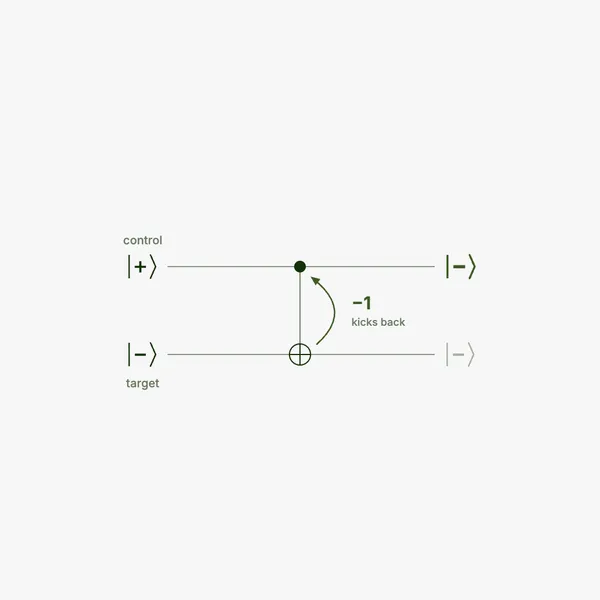
Run it. Now the state is (|00⟩ minus |11⟩) over √2, the same perfect correlation but with a relative phase between the two terms, |00⟩ and |11⟩, the kind of phase a later post is entirely about. The four differ in which outcomes correlate and in that internal sign, and because they are mutually orthogonal they can be told apart from one another with certainty, which is exactly why they show up everywhere from teleportation to error correction. The point for now is just that entanglement is a family, not a single trick, and small changes to two gates walk you around it.
A deep limit hiding nearby: you cannot copy a qubit
Worth knowing, because it explains why entanglement is used the way it is. You cannot copy an unknown quantum state. There is no operation that takes an arbitrary qubit and produces two identical copies of it. This is the no cloning rule, and it is not an engineering limitation that better hardware will fix, it is a theorem, a flat consequence of how quantum mechanics works.
It follows from something the gates post already established: gates are matrices, and matrices are linear. A machine that copied any state you handed it would have to behave inconsistently on superpositions, and linearity simply forbids that. The intuition people usually reach for is that to copy a state you would first have to know it, and to know it you would have to measure it, and measuring collapses it, destroying the very thing you wanted to duplicate. That is not the proof, but it points in the right direction. Either way you are stuck. The original is all you get.
This sounds like a pure restriction, and it is the reason quantum teleportation has its odd name. You cannot clone a qubit to send a copy elsewhere, so the only way to move a quantum state from here to there is to transfer it, consuming the original in the process. The state ends up at the destination and is gone from the source, a move and not a copy, forced by no cloning. And the resource that makes that move possible, the channel it travels through, is a shared entangled pair. The limit and the entanglement work together, which is why they belong in the same post.
Where entanglement earns its keep
This is not a curiosity off to one side. Entanglement is the resource behind the parts of quantum computing that have no classical shadow. Quantum teleportation uses it to move a state from one qubit to another. Superdense coding uses it to pack two classical bits into the transmission of one qubit. The algorithmic speedups lean on it heavily. When people say quantum is more than a fancy probabilistic computer, entanglement is a large part of what they mean, because it is correlation that no separate, independent description can reproduce. Each of those uses deserves its own post, and will get one. For now it is enough to know that the two line recipe above is the doorway to all of it.
A quick test before you move on
Close this and answer in your own words.
If you measure one qubit of a Bell pair and get 1, what will the other give, and how sure are you? If your answer is not the other is 1, with certainty, reread the measurement section.
Why can you not use an entangled pair to send a message faster than light? If the word random is not central to your answer, the no communication section did not land.
And what does it actually mean to say a state is entangled, in terms of describing the two qubits? If you cannot say something like the parts have no separate description, go back to the section on the whole and the parts, because that is the definition the rest hangs on.
Where I am learning it
Free. 3Blue1Brown and the usual visual explainers are good for the geometry of it, though I will warn you that a lot of popular material leans straight into the spooky framing this post is trying to undo, so read it with that filter on. The cleanest mental model came from building the Bell state myself and poking at it, measuring it, taking its marginals, trying and failing to factor it into two separate qubits. As with everything else I write, the correlation I had only read about did not become real until I made two qubits agree on my own machine and watched the mixed outcomes stay stubbornly empty.
The spooky was the marketing
Entanglement was sold to me as the part of quantum I would never really understand, the mystical core, action at a distance, give up and accept it. It is a correlation you can build in two gates. The qubits agree perfectly, each one alone looks like noise, and you cannot use any of it to send a signal, because the agreement only shows up when you compare notes the slow way.
What is left, once the marketing is gone, is stranger and better than the marketing was: a correlation stronger than any advance agreement could produce, confirmed in the lab again and again, and still argued over by people who agree completely on every number it returns. The spooky was a slogan. The thing underneath is real, buildable, and now yours to make whenever you want.