Superdense coding: the mirror image of teleportation
Two classical bits through one qubit, with a shared Bell pair as fuel. The mirror of teleportation, built and verified.

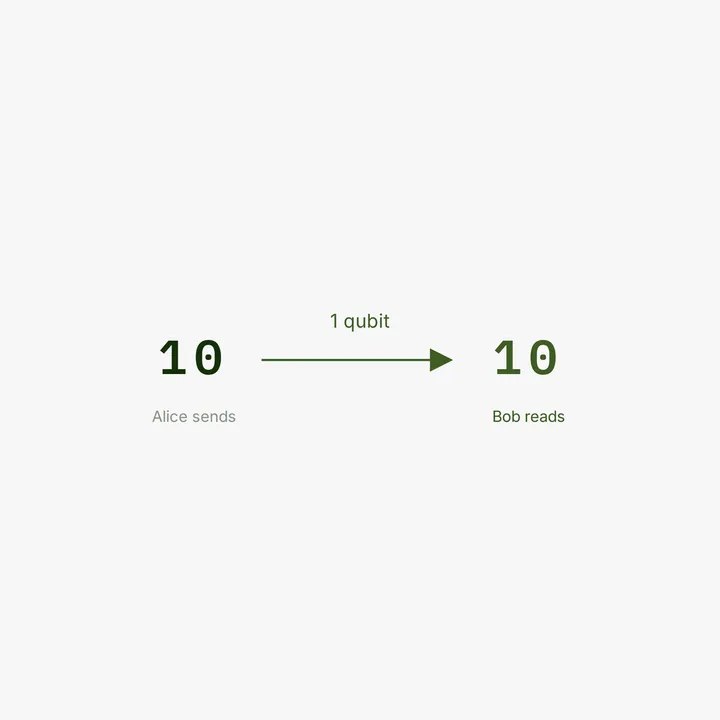
The last post moved a qubit's worth of quantum state from one place to another using two classical bits and a shared entangled pair. Superdense coding is its mirror image, and the symmetry is so clean it is almost funny. Teleportation sends quantum information using classical bits. Superdense coding sends classical information using a qubit. Same ingredients, opposite direction. You send two classical bits to someone by physically transmitting just a single qubit. Here is the mirror, built from scratch.
The setup
Alice and Bob share a Bell pair, distributed ahead of time, when it was convenient. Alice holds one half, Bob holds the other. Later, Alice finds she has two classical bits she wants to send to Bob, but she can only physically transmit a single qubit to him. With nothing pre shared, one qubit can carry at most one bit of classical information that you can reliably read out. The shared entanglement changes that. Using the Bell pair they already have, Alice can pack two classical bits into the one qubit she sends. That doubling, two bits out of one transmitted qubit, is the trick, and it is why the protocol is called superdense.
The protocol
Four steps, and the second one is where the magic is hidden. First, Alice and Bob share a Bell pair, set up earlier. Second, Alice looks at her two bits and applies one of four operations to her half of the pair: do nothing for 00, an X gate for 01, a Z gate for 10, or both Z and X for 11. Third, Alice sends her single qubit to Bob. Fourth, Bob, now holding both qubits, performs a Bell measurement, a CNOT then a Hadamard then measure, and reads out the two bits Alice encoded.
Building it
Here is the whole protocol, run for all four possible messages, so you can see every one arrive intact.
from qiskit import QuantumCircuit
from qiskit.primitives import StatevectorSampler

def superdense(message):           # message is a two character string, like '10'
    qc = QuantumCircuit(2, 2)
    qc.h(0); qc.cx(0, 1)           # shared Bell pair: Alice has qubit 0, Bob qubit 1
    a, b = message[0], message[1]
    if b == '1': qc.x(0)           # Alice encodes her two bits on her qubit
    if a == '1': qc.z(0)
    qc.cx(0, 1); qc.h(0)           # Bob decodes with a Bell measurement
    qc.measure(0, 0); qc.measure(1, 1)
    return qc

sampler = StatevectorSampler()
for message in ['00', '01', '10', '11']:
    counts = sampler.run([superdense(message)], shots=400).result()[0].data.c.get_counts()
    raw = list(counts.keys())[0]
    decoded = raw[-1] + raw[-2]    # qubit 0 is the first bit, qubit 1 the second
    print(f"Alice sends {message}  ->  Bob reads {decoded}")
Run it. Every message comes back exactly as sent. Alice sends 00 and Bob reads 00, she sends 11 and Bob reads 11, all four perfect. One physical qubit travelled from Alice to Bob, and two classical bits arrived. Notice the small bit ordering step in the decode: Qiskit writes its measurement strings with qubit 0 on the right, the little endian convention that has come up before, so I read qubit 0 as the first bit and qubit 1 as the second to line the message back up. With that handled, the round trip is clean: two bits in, one qubit sent, two bits out.
Why it works
The mechanism is elegant once you see it. The shared Bell pair starts in one particular entangled state. Alice's four possible operations, nothing, X, Z, or both, transform that starting state into four different entangled states, the four Bell states from the entanglement post. And those four Bell states are perfectly distinguishable from one another: a Bell measurement, the CNOT then Hadamard combination, maps each one to a different pair of bits with certainty. So Alice's choice of operation selects which of the four Bell states the pair is in, and Bob's Bell measurement reads off which one it is, recovering two bits. The entanglement is what makes this possible. Without the shared pair, Alice's single qubit could only carry one bit. With it, her local operation steers a two qubit state that Bob can fully resolve, and two bits come through.
The four operations, the four Bell states
It is worth making the mechanism concrete, because it ties straight back to the entanglement post. Recall the four Bell states, the maximally entangled two qubit states everybody actually uses, which form a complete, perfectly distinguishable set. Alice's four operations are precisely the four moves that walk the shared pair from its starting Bell state to each of the other three and back to itself. Doing nothing leaves it where it is. The X gate moves it to one neighbour, the Z to another, and both together to the fourth. So Alice's two bits are really a choice of which of the four Bell states to put the pair into.
And that is exactly the choice Bob can read, because a Bell measurement is the operation that distinguishes the four Bell states with certainty, the CNOT then Hadamard combination mapping each one to a unique pair of outcomes. So the whole protocol lines up cleanly: Alice selects one of four Bell states with a local operation on her qubit, sends that qubit, and Bob's Bell measurement identifies which of the four she chose, recovering both bits. The four operations and the four Bell states and the four measurement outcomes are the same four, viewed at three stages of the protocol. Once you see that the encoding is a choice among the Bell states and the decoding is the measurement that tells them apart, superdense coding stops being a trick and becomes obvious.
Why not three bits, or more
A natural follow up: if entanglement lets one qubit carry two classical bits, why stop at two? Could a cleverer scheme push three bits, or ten, through a single qubit? No, and the limit is fundamental. There is a hard ceiling, a result in quantum information theory, on how much classical information a quantum system can carry. A single qubit, with no help, conveys at most one classical bit you can reliably read out. With pre shared entanglement, that doubles to two, and superdense coding achieves exactly that doubling, hitting the ceiling. But it cannot be beaten. Entanglement buys you a factor of two and no more, and no protocol, however ingenious, extracts three reliable classical bits from one transmitted qubit.
So superdense coding is not just a clever scheme, it is an optimal one, saturating the best that physics allows. That is worth knowing for the same reason the Grover post insisted its speedup was provably optimal: it is the honest, calibrated way to hold these results. Entanglement is a real and powerful resource, and it has precise limits, and superdense coding sits exactly at one of them. Two bits per qubit with entanglement, one without, and that is the whole of what is possible.
The honest accounting
There is an obvious objection, and answering it is important, because otherwise this looks like a free lunch that breaks information theory. Did Alice really send two bits using only one qubit's worth of resources? No, and the accounting is the honest part. The shared Bell pair had to be distributed beforehand, which means a qubit had to travel between Alice and Bob earlier, when they set up the entanglement. So the true cost is one qubit sent earlier, to share the pair, plus one qubit sent now, to deliver the message. Two qubit transmissions in total, for two bits. It is not compression below the information limit. It is clever timing.
And that timing is the actual practical value. The expensive, entanglement distributing step can happen whenever it is convenient, ahead of time, when bandwidth is cheap or the channel is quiet. Then later, when Alice actually has a message and perhaps a tight channel, she only needs to send one qubit to deliver two bits. You front load half the cost into a quiet moment and pay the rest in a single qubit when it counts. No law is broken, the books balance, and the benefit is real: you have shifted when you pay, not avoided paying.
The mirror with teleportation
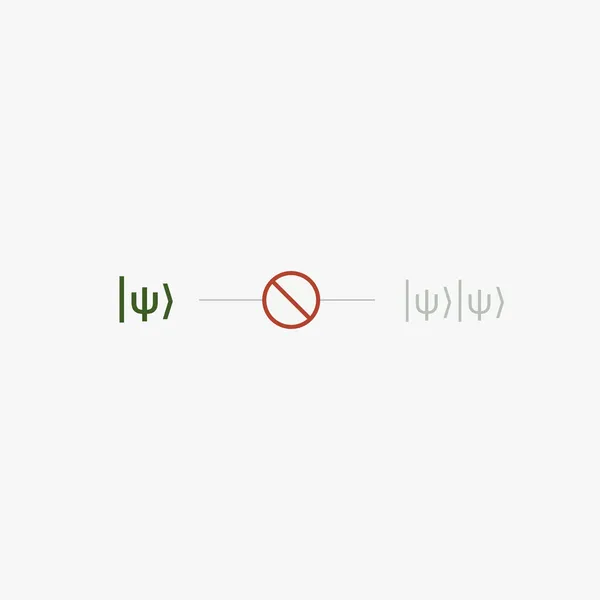
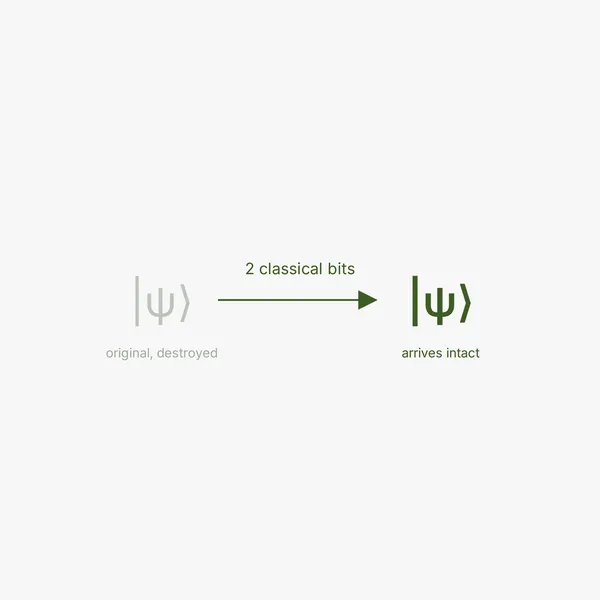
Put the two protocols side by side and the symmetry is perfect. Teleportation sends one qubit's worth of quantum state using two classical bits plus a shared Bell pair. Superdense coding sends two classical bits using one qubit plus a shared Bell pair. Each one trades the currency the other delivers. Each one consumes a shared entangled pair as fuel. They are duals, two faces of the same underlying fact, that entanglement is a resource you can spend to trade between quantum and classical communication. Understanding one makes the other click, because they are the same idea viewed from opposite ends, and seeing that symmetry is one of the small joys of learning this material.
Where it is used
Superdense coding is a foundational result in quantum communication, the cleanest demonstration that pre shared entanglement boosts how much classical information a quantum channel can carry. It sits at the conceptual root of a whole area called entanglement assisted communication, and while you will not be using it to speed up your internet tomorrow, it is one of the results that defines what entanglement is good for. As a proof of principle, it is foundational.
What it is and is not, today
A word of calibration, in the spirit of the rest of this series. Superdense coding is a proven result, demonstrated in real experiments, and it is conceptually foundational, one of the clearest illustrations of entanglement as a usable communication resource. It is not, today, something speeding up your network connection, and it is worth being clear about why. Distributing and maintaining the shared entanglement reliably, over real distances, through real noise, is hard with current technology, and the overhead of doing so can outweigh the benefit for most ordinary communication. So like much of what this series has covered, superdense coding lives at the intersection of genuinely real and not yet practically transformative.
That is not a knock on it. It is the honest position for a result whose value is partly present and partly potential. The principle is solid and the experiments confirm it, and as the technology for distributing and storing entanglement matures, the practical relevance grows with it. For now, its importance is conceptual and foundational, a piece of the picture of what entanglement makes possible, and a building block in the theory of quantum communication. Holding that calibrated view, real and proven but not yet world changing, is exactly the habit the NISQ post argued for, applied to one more piece of the field.
A quick test before you move on
Close this and answer in your own words.
How many classical bits does Alice send, and how many qubits does she physically transmit to do it? If two bits, one qubit is not your answer, reread the setup.
Why is this not a violation of information limits? If your answer does not mention that the Bell pair had to be distributed beforehand, costing an earlier qubit, revisit the honest accounting.
And in what precise sense is superdense coding the mirror of teleportation? If you cannot say one trades classical bits for a qubit's state and the other trades a qubit for two classical bits, both using a Bell pair, reread the mirror section.
Where I am learning it
Free. Superdense coding sits right next to teleportation in every quantum computing course and the IBM Quantum materials, and the two are best learned as a pair because the symmetry teaches you more than either alone. What made it concrete for me was running all four messages and watching each one round trip perfectly, then sitting with the accounting until I was sure no free lunch was being served. As always, the claim did not land until I had sent all four messages through my own circuit and seen them arrive intact.
The same insight wearing two costumes
Teleportation and superdense coding are the same insight wearing two costumes. Spend a shared entangled pair, and you can trade between quantum and classical information in either direction: send a qubit's state with two classical bits, or send two classical bits with one qubit. Neither breaks any law once you account for the entanglement you spent to do it.
What I take from the pair is that entanglement is not just a strange correlation to marvel at, it is a usable resource, a kind of fuel you stockpile in advance and spend to do communication you otherwise could not. That reframing, from entanglement as a curiosity to entanglement as a currency, is one of the shifts that made the whole field feel less like magic and more like engineering with an exotic new primitive. The mirror is where I first really felt that.