Quantum teleportation is not what the name promises
What moves is information, not matter, the original is destroyed, and nothing travels faster than light. Still remarkable.

The word teleportation does this topic no favours. It promises Star Trek, a body dissolving in one place and reassembling in another, matter flung across space. Quantum teleportation is none of that. No matter moves. Nothing travels faster than light. And to finish the job, you still have to make an ordinary phone call. The name oversells the science fiction and, strangely, undersells the real thing, because what actually happens is more subtle and more useful than the word suggests. Here is what teleportation genuinely does, built from scratch.
What it actually moves
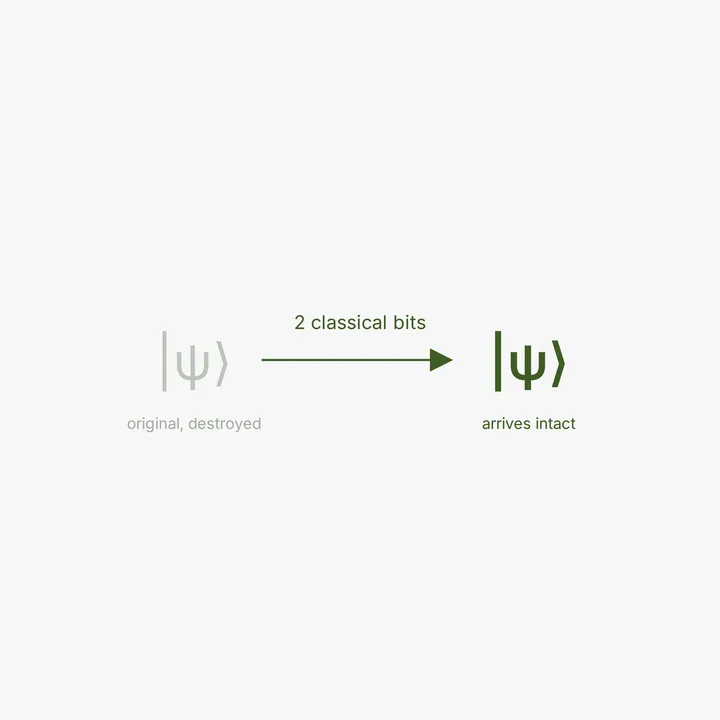
Quantum teleportation moves the state of a qubit from one place to another. Not the qubit itself, the state it is in. You have a qubit here in some unknown quantum state, call it |ψ⟩, and you want a qubit over there to end up in exactly that state. Teleportation does this without physically moving your qubit across the gap, and, remarkably, without ever measuring or learning what |ψ⟩ is. The destination qubit ends up in the state |ψ⟩, perfectly, while you never found out what you were sending.
And there is a catch built into the physics: the original is destroyed in the process. After teleportation, your qubit is no longer in the state |ψ⟩. The state has moved, not copied. This is not an implementation detail, it is forced by the no cloning rule, which gets its own post soon, and which says you cannot have two copies of an unknown state. So teleportation respects that law by construction: the state arrives at the destination exactly as it leaves the source. A move, never a duplication.
Why you would even want this
It sounds like a strange thing to need, so here is the motivation. You cannot copy an unknown quantum state, by no cloning. And if you try to measure it to learn it and rebuild it elsewhere, the measurement collapses it and you get one outcome, not the state. So moving an unknown quantum state from one qubit to another is genuinely non trivial, and the obvious approaches are all blocked. Teleportation is the protocol that threads the needle, transferring the state intact without copying it and without measuring it. That is the problem it solves.
The ingredients
Three things, built from ingredients covered in earlier posts. A shared entangled pair, a Bell pair, distributed between the two parties ahead of time. A Bell measurement, which is the CNOT then Hadamard then measure combination. And two classical bits, ordinary ones, sent over an ordinary channel.
The protocol, step by step
Set the scene with three qubits. Alice holds the qubit in the unknown state |ψ⟩, call it qubit 0. Alice and Bob share a Bell pair, with Alice holding qubit 1 and Bob holding qubit 2. The goal is to get |ψ⟩ onto Bob's qubit 2.
First, Alice entangles her unknown qubit with her half of the Bell pair by doing a Bell measurement on qubits 0 and 1, a CNOT from 0 to 1, then a Hadamard on 0, then measuring both. This gives her two classical bits, and crucially it tells her nothing about |ψ⟩, the outcomes are random. Second, Alice sends those two classical bits to Bob over a normal channel, a phone call, an email, anything. Third, Bob, depending on the two bits he receives, applies a correction to his qubit, an X gate, a Z gate, both, or neither. After that correction, Bob's qubit is in the state |ψ⟩.
Building it
Here is the whole thing in code. I am using the deferred measurement form, where Alice's measurements and Bob's classically controlled corrections are replaced by quantum controlled gates, which is the standard, simulator friendly way to verify teleportation and produces an identical result. A controlled correction now stands in for measure then correct.
from qiskit import QuantumCircuit
from qiskit.quantum_info import Statevector, partial_trace, DensityMatrix, state_fidelity

qc = QuantumCircuit(3)
qc.ry(1.0, 0)            # qubit 0 = some unknown state |psi>
qc.h(1); qc.cx(1, 2)     # Bell pair shared on qubits 1 (Alice) and 2 (Bob)
qc.cx(0, 1); qc.h(0)     # Alice's Bell measurement basis on qubits 0 and 1
qc.cx(1, 2); qc.cz(0, 2) # Bob's corrections, applied to qubit 2

# what state did qubit 2 end up in?
bob = partial_trace(Statevector(qc), [0, 1])
psi = QuantumCircuit(1); psi.ry(1.0, 0)   # the original state, for comparison
print(round(float(state_fidelity(DensityMatrix(bob), Statevector(psi))), 6))   # 1.0
Run it. The fidelity between Bob's final qubit and the original |ψ⟩, the overlap between two states, is 1.0, a perfect match. The state that started on qubit 0 is now sitting on qubit 2, exactly, having never been measured or copied. Change the preparation on qubit 0 to any state you like and it still arrives perfectly. That is teleportation: the unknown state moved across the circuit, intact, while the original was consumed in the process.
A word on the code form I used
The circuit above is worth one clarification, because it does not look exactly like the protocol I described in words. In the real protocol, Alice measures her two qubits, gets classical bits, and Bob applies corrections conditioned on those classical bits. In the code, I replaced the measure then conditionally correct steps with quantum controlled gates, a CNOT and a controlled Z reaching directly onto Bob's qubit. This is the deferred measurement principle, and it is a standard, important fact: a measurement followed by a gate conditioned on the result gives exactly the same outcome as a quantum controlled gate followed by a measurement. You can slide the measurement to the end without changing anything observable.
I use this form for two reasons. It is cleaner to verify on a simulator, because the whole thing stays a single quantum state I can inspect with the statevector tools, rather than branching on random measurement outcomes. And it makes the logic transparent, since the corrections appear as ordinary gates rather than classical control flow. The physics is identical to the measure and correct version, the deferred measurement principle guarantees it, so the fidelity of one that you saw is the real result. When you eventually write the literal protocol, with actual measurements and classical conditioning, it behaves the same way. The deferred form is just the version that is easiest to run and check, and understanding that the two are equivalent is itself a useful piece of quantum computing fluency.
The three honest points
Now the part the name obscures, stated plainly, because each correction matters.
No matter moved. Bob's qubit was always sitting there at Bob's end. Nothing physical travelled from Alice to Bob. Only the state, the information about how the qubit is configured, got transferred. There is no beam, no dissolving, no reassembly of stuff.
The original was destroyed. After the protocol, Alice's qubit is no longer in the state |ψ⟩. You end with one qubit in the state, at Bob's end, not two. It is a move, and no cloning is the reason it has to be.
It is not faster than light, and this is the one people most want to be wrong about. Before Bob applies his correction, his qubit is in a random, useless state. He cannot know it is |ψ⟩ until he applies the right correction, and he only knows which correction to apply once he receives Alice's two classical bits. Those bits travel over an ordinary channel, no faster than light. Without them, Bob has nothing. So although entanglement does part of the work instantly, the protocol cannot complete until the classical message arrives, and that message obeys the cosmic speed limit. No information reaches Bob faster than light. The entanglement is necessary but not sufficient, and the classical phone call is what rate limits the whole thing.
Why it is still remarkable
Strip away the false sci fi promise and what remains is genuinely astonishing. You moved an unknown quantum state from one place to another, perfectly, without ever learning what it was and without copying it. Classically there is no analogue to this. You cannot move information you are forbidden to read or copy, and yet teleportation does exactly that, using entanglement as the channel and two classical bits as the key that unlocks it. That is a real and deep capability, even though it is nothing like the transporter the name evokes.
Where it is used
Teleportation is not a curiosity. It is a foundational building block of quantum networks, the way you move a quantum state between two processors or two nodes that are not directly connected. It is the mechanism behind quantum repeaters, which would extend quantum communication over long distances. And it appears as a subroutine inside larger protocols. It is plumbing, the unglamorous and essential kind, for any future where quantum information has to travel.
The longer distance problem is worth a moment, because it is where teleportation becomes genuinely important rather than merely elegant. Quantum states are fragile, and sending a qubit directly down a long fibre means it degrades and is lost to noise over distance, with no way to amplify it, since amplifying would mean copying, which no cloning forbids. Teleportation offers a way around this. If you can establish entanglement between distant nodes, in stages, refreshing it as you go, you can teleport a state across the whole distance using that entanglement and classical messages, without ever sending the fragile qubit itself down the full length of the channel. This is the core idea behind the so called quantum internet, a future network for distributing quantum information between distant machines, and teleportation is one of its load bearing primitives. So the protocol that sounds like science fiction is, in practice, a candidate answer to a very practical engineering problem: how to move quantum information across distances that would otherwise destroy it.
Why exactly two classical bits
It is worth understanding why the number is two, not one, not three, because it illuminates how the protocol works. When Alice does her Bell measurement, there are four possible outcomes, the four combinations of two bits: 00, 01, 10, 11. Each outcome corresponds to a different way the unknown state got scrambled onto Bob's qubit during the entangling. Bob's qubit, before correction, is in the original state |ψ⟩ but transformed by one of four possible operations, and which one depends entirely on Alice's measurement outcome.
So Alice's two bits are a label, telling Bob exactly which of the four scramblings happened, so he knows precisely how to unscramble. If the bits say one thing, his qubit needs no correction, it is already |ψ⟩. If they say another, it needs an X to undo a flip. Another, a Z to undo a phase. The last, both. Two bits, four messages, four corrections, a perfect match. You need two bits because there are four possible scramblings to distinguish, and two bits is exactly enough to name one of four things. Fewer than two could not tell the four cases apart, and Bob would not know how to correct. That is the information theoretic reason the protocol costs precisely two classical bits, no more and no less.
Three misconceptions worth killing
Because the name invites them, let me put down the three wrong pictures explicitly. First, that something physical travels. It does not. The qubit at the destination was already there; only its configuration changed to match the source. There is no beam and no transported substance. Second, that you could use it to communicate instantly across space. You cannot, because the destination qubit is useless noise until the classical bits arrive over an ordinary channel at ordinary speed, so the protocol never outpaces light. Third, that the state gets copied to a second location while the original remains. It does not; the original is necessarily destroyed, because copying an unknown state is forbidden, so teleportation is always a move. Hold those three corrections and the word stops misleading you. No transport of matter, no faster than light signalling, no copy. What is left is the real and remarkable thing: an unknown state moved intact, unread and unduplicated, across a gap.
A quick test before you move on
Close this and answer in your own words.
What exactly gets transferred in teleportation, and what happens to the original? If you cannot say the state moves and the original is destroyed, reread the what it actually moves section.
Why is teleportation not faster than light communication? If your answer does not centre on Bob needing the two classical bits to finish, revisit the three honest points.
And why does the original have to be destroyed? If you cannot connect it to no cloning, that is the thread a later post picks up directly.
Where I am learning it
Free. Teleportation is in every quantum computing course and the IBM Quantum learning materials, and it is worth building yourself because the protocol is small enough to hold in your head once you have entanglement and Bell measurements down. The thing that made it click was verifying that the state really arrives, preparing some specific state, running the protocol, and confirming the destination qubit matches it perfectly. As always, the claim that an unknown state moved intact did not convince me until I watched the fidelity come back as one on my own machine.
The name was the problem
Quantum teleportation sounds like the most science fiction thing in the field, and it is one of the most grounded. No matter moves, nothing outruns light, and the whole thing hinges on an ordinary classical message to complete. What actually happens is the transfer of an unknown quantum state from one qubit to another, perfectly, without reading it or copying it, using entanglement as the channel.
That is stranger and more useful than teleporting a body, once you stop expecting the body. The lesson, again, is to look past the marketing word to the real mechanism underneath, where the genuine wonder lives. Teleportation moves information you are not even allowed to look at. That deserves a better name, but it does not need a more impressive one.