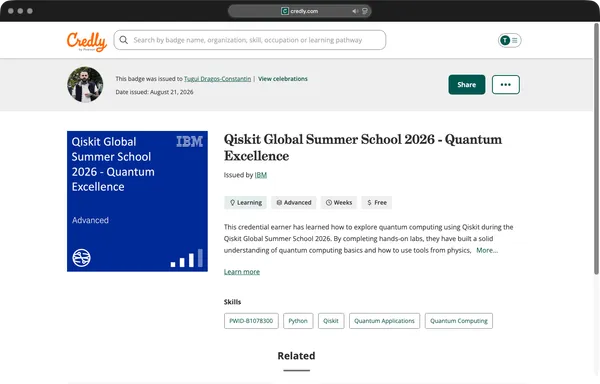
I just earned my second IBM Quantum badge, and it says Advanced
My first IBM Quantum badge said Intermediate and it bent my brain. The second one says Advanced. It is about the algorithms that actually run on today's noisy quantum machines, and I am a self-taught builder who was not supposed to get here.

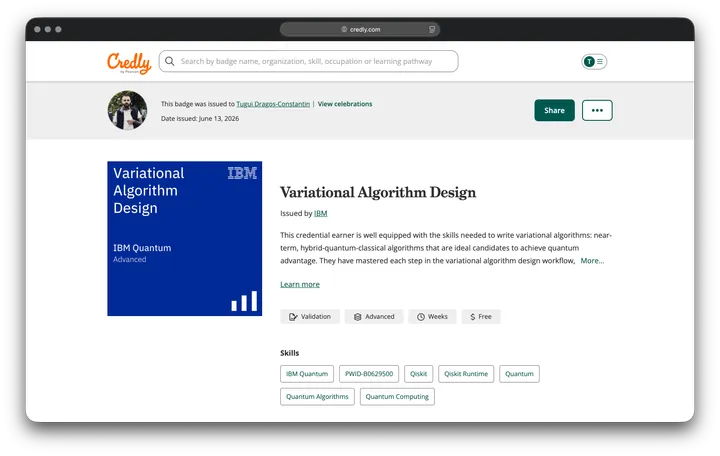
A few weeks ago I earned my first IBM Quantum badge. It was labelled Intermediate, and it bent my brain in directions it had never gone. Yesterday I earned the second one. It is labelled Advanced, and I am going to tell you exactly what that word is doing there.
I am a self-taught builder. No computer science degree, no bootcamp, no corporate training program. I came into quantum computing from the world of automation and software, by reading one paragraph too many and refusing to put it down. I am telling you this again because it is the whole point of what follows. An Advanced badge from IBM is not the kind of thing the version of me from two years ago would have believed was on the table.
This post is about one thing: the badge itself. What Variational Algorithm Design actually is, what it covers, and what it took to earn it. Not a plan, not a roadmap. Just the marker, and an honest look at it.
The jump from Intermediate to Advanced
My first badge, Fundamentals of Quantum Algorithms, was about the canon. Deutsch-Jozsa, Simon, Grover, the Quantum Fourier Transform. The algorithms that prove, on paper and with full rigour, that a quantum computer can do certain things with far fewer steps than a classical one. That badge taught me to reason about quantum advantage: when it appears, how large it is, and under what assumptions.
This one is a different kind of hard.
Variational Algorithm Design is not about textbook algorithms that assume a perfect, error free machine. It is about the algorithms we can actually run on the noisy quantum computers that exist right now. That distinction matters more than almost anything else in this field, so let me be plain about it. We are in the NISQ era: Noisy Intermediate-Scale Quantum. The machines have tens to hundreds of qubits, and those qubits are noisy. There is no full error correction yet. The algorithms that run usefully on hardware like this are a specific family, and that family is exactly what this badge is about.
These are near term, hybrid quantum classical algorithms. They are the strongest current candidates for real quantum advantage in the noisy era. Notice the word candidates. This is not a claim that the advantage is proven and sitting on a shelf somewhere. It is a claim that this is where the serious near term work lives. I would rather tell you that honestly than sell you something shinier.
What Variational Algorithm Design actually covers
The core idea is simpler than the name makes it sound, and genuinely beautiful once it lands.
You build a quantum circuit with knobs on it. Not fixed gates, but parameterised ones, with angles you can turn. Then you set up a loop. The quantum computer runs the circuit and measures a result. A classical optimiser looks at that result, decides the knobs are not quite right, and adjusts them. Run again. Measure again. Adjust again. The quantum machine and the classical machine pass the problem back and forth until the answer settles. That loop is the whole engine, and this badge is about designing every part of it well.
Here is what that breaks down into:
The ansatz. This is the parameterised circuit itself: a starting reference state plus a form with tunable rotations and entangling gates. Choosing it is a real design decision. Too simple and it cannot represent the answer. Too complex and you cannot train it or run it on noisy hardware.
The cost function. This is what you are trying to minimise, usually the expected value of an observable, a measurable quantity such as energy. In chemistry that observable is a Hamiltonian, the operator that encodes the molecule's energy, and the minimum is the ground state energy of a molecule. You estimate it using Qiskit Runtime primitives, the Estimator and the Sampler, which are the tools the entire course is built around.
The classical optimiser. This is the part that turns the knobs. It is an ordinary classical optimisation algorithm hunting for a minimum, and picking the right one, and understanding how it behaves, is half the battle.
The design tradeoffs. Weights, penalties, oversampling, undersampling. The course spends real time on the levers you pull to make a custom variational algorithm behave, not just the clean textbook version.
On top of that workflow, the badge walks through the algorithms that use it. The Variational Quantum Eigensolver, or VQE, is the archetype. It finds the lowest energy state of a system, which is why it matters so much for chemistry and materials science. There are extensions of it for finding excited states, and there is the Quantum Approximate Optimization Algorithm, QAOA, which goes after combinatorial optimisation problems like max-cut, splitting a network into two halves that cut as many links as possible. At least one of the worked examples is not a simulation. It runs on real IBM quantum hardware, which is the part that keeps all of this honest.
What it actually demanded
I want to be straight about the learning curve, because a lot of quantum content is not.
This badge sits on top of things you cannot skip. Linear algebra, because states are vectors and gates are matrices. The Born rule, because a measurement gives you a probabilistic outcome, not a fixed value. Expectation values, because the entire cost function is the expected value of an observable, and if that phrase does not mean something concrete to you, the variational loop is just symbols on a page. None of it is beyond a determined self-learner. I am the proof of that. But it is a real technical discipline, and the badge treats it like one.
The credential is earned through an exam on IBM Training after you work through the course. Twenty questions, and you need eighty percent to pass. It is not a slideshow with a participation trophy at the end.
The thing that made it click for me, the part I keep returning to, is that this is the first place where quantum and classical computing genuinely operate as one system. Not quantum replacing classical. The two of them locked in a loop, each doing the part it is good at. For someone who has spent years wiring systems together so they hand work back and forth, that architecture felt strangely familiar and completely new at the same time. That is the moment I knew this one was going to stay with me.
Why this one matters to me
I started down this road as someone who, by the usual rules, is not supposed to be here, still learning in public with all the gaps showing.
An Advanced badge from IBM Quantum does not erase that starting point. It does something better. It says the starting point was never the ceiling. The work is the ceiling, and the work is doable.
I am putting this on the record the same way I put everything else here: openly, with the date stamped on it, so the version of me a year from now can look back and see exactly where this point was. If you are a builder, a developer, or anyone who refuses to stay at the surface of a hard thing, you are welcome to follow along. No newsletter, no funnel, no noise. The posts are just here, in the open, as the work happens.
The first badge said Intermediate. This one says Advanced. I am exactly where I wanted to be, and I am not slowing down.