Active recall for hard technical subjects
Rereading feels like progress and barely works. The method that actually retains hard material, and why it feels worse while it works.

There is a specific feeling I have learned to distrust. It is the feeling, at the end of a study session, that I have got it. The page made sense. Every line followed the last. I nodded along the whole way and closed the laptop satisfied. And then a week later I sit down to use the thing and discover I have almost nothing. The understanding I was so sure of has evaporated, and I am back at the start.
That feeling is a liar, and learning to distrust it is the most useful study skill I have. Here is the method I use instead, the one that actually retains hard technical material, and a warning up front: it feels worse the entire time it is working.
The gap between feeling fluent and actually knowing
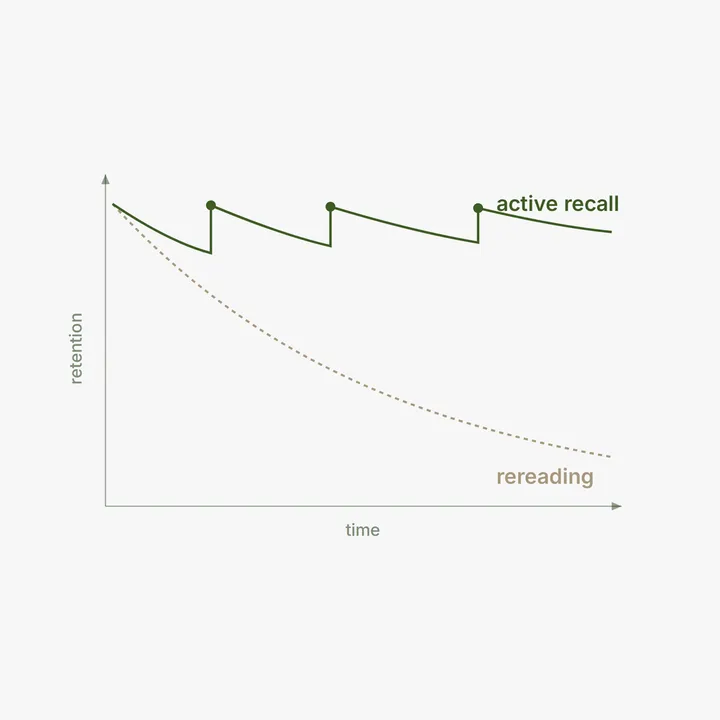
The comfortable way to study is to read, highlight, maybe reread the highlights, and let the growing sense of familiarity feel like progress. It is pleasant. It is also mostly useless, and the reason is subtle. Rereading builds fluency, the easy recognition of material you have seen before. Fluency feels exactly like knowledge from the inside. But recognising something when it is in front of you is a completely different skill from producing it when it is not, and only the second one is what you need when you sit down to solve a problem or write a circuit. You can reread an explanation ten times, feel more confident each time, and be no better at reproducing it on a blank page. The confidence grows. The actual ability does not. That gap is where most study time quietly disappears.
The one principle: retrieval, not review
Everything that works rests on a single finding, and it is worth saying plainly because it is counterintuitive. You build durable memory by pulling information out of your head, not by putting it back in. The effort of retrieving something, of dragging it up from memory when it is not in front of you, is the thing that strengthens it. Researchers call it the testing effect, and it is one of the most robust results in the science of learning. A session spent testing yourself beats a session spent rereading, and not by a little, even though the rereading feels far more productive while you do it.
So the shift is from input to output. Stop asking how do I get this into my head. Start asking how do I practise getting it out. Every technique below is just a different way to make yourself retrieve.
Active recall in practice
The core move is almost stupidly simple. Close the source. Take a blank page. Reproduce what you just learned from memory, in your own words, as completely as you can. Then, and only then, open the source and check what you missed.
The magic is in what happens while you struggle. The places where you stall, where the next line will not come, where you realise you can state the idea but not actually derive it, those stalls are the whole point. They are your real gaps, made visible. The smooth reread hid them. The blank page exposes them in seconds. For technical material this gets concrete and even better. Do not just recall that there is a Hadamard matrix, write it out. Do not recall that a gate is unitary, re derive why. Do not recall that the answer was fifty fifty, recompute it by hand. Production, not recognition. Every self test at the end of the other things I write is this principle in disguise.
Recall is not rote memorisation
A worry I had at first, and maybe you have it too: this sounds like flashcard cramming, memorising facts I do not understand. It is the opposite, and the distinction matters. Rote memorisation is storing a string of symbols you could not reconstruct if you lost them. Recall, done right, is rebuilding understanding from the pieces, not reciting it from a cache.
The test is whether you could regenerate the thing if you forgot the exact words. If I ask you for the Hadamard matrix and you have only memorised the four numbers, that is rote, and it is brittle, because the moment you blank you have nothing. But if you can recall that a Hadamard turns |0⟩ into an equal superposition and reconstruct the matrix from what it has to do, that is understanding, and it survives forgetting the surface. So when you sit at the blank page, do not just try to dredge up the words. Try to rebuild the idea from its reasons. Recall the why, and the what comes back with it. That is the difference between knowledge you can use and a fact that crumbles the first time it is tested under pressure.
Spaced repetition: review just before you forget
Recall once and the memory is stronger, but it still fades. The trick is when you recall again. Memory decays along a curve, fast at first then slower, and the most efficient moment to review something is right as you are about to lose it. Review too soon and you waste effort on something still fresh. Review too late and you are relearning from scratch. Hit the sweet spot, just before forgetting, and each review resets the memory stronger and buys you a longer interval before the next one.
You do not have to track this by hand. Spaced repetition software, Anki being the free standard, schedules it for you. You make small cards, you answer them, you tell it whether you got each one, and it decides when to show each card again, stretching the gaps as the memory hardens. The discipline that matters is what you put on the cards. Not everything. The load bearing facts. What is the Hadamard matrix. What does the plus state give when you measure it in the standard basis, the ordinary 0 and 1 basis. What does it mean for a gate to be unitary. Small, atomic, the things everything else leans on. A deck of two hundred sharp cards you actually review beats two thousand you made once and abandoned.
The Feynman technique: explain it to a beginner
This one is recall wearing a different hat, and it is brutal in the best way. Take the thing you think you understand and explain it, out loud or on paper, as if to someone who knows nothing. Simple words. No jargon to hide behind.
You will get a few sentences in and hit a spot where you go "and then it sort of just works out," and you wave your hand. That hand wave is the sound of a gap. Plain language is a lie detector for understanding, because jargon lets you gesture at an idea without actually having it, and stripping the jargon away leaves you nowhere to hide. When you hit the hand wave, you have found exactly what to go relearn. Patch it, then try the explanation again from the top. When you can explain it cleanly to an imaginary beginner, with no fog and no jargon crutches, you actually have it. Until then you have the feeling, not the thing.
Interleaving: mix the topics up
The last technique is the one that feels most wrong. The intuitive way to study is in blocks. All of the matrix algebra, then all of the Python, then all of the quantum. It feels focused and orderly. It is also weaker than the alternative, which is to mix them. Do a bit of matrix algebra, then a Python snippet, then a circuit, then back to a different bit of algebra, all in one session.
Interleaving feels harder because it is harder. Every time you switch, you have to reload the context and, crucially, decide which approach this problem even needs. And that deciding is the skill you actually want. Blocked practice lets you run the same method ten times on autopilot, which feels great and teaches you almost nothing about when to reach for it. Interleaved practice forces you to choose the tool, every time, which is exactly what real problems demand, because real problems do not come labelled with the chapter they are from. It is slower and more frustrating in the room. It retains far better out of it.
Why this matters even more for technical subjects
Hard technical material has a property that makes all of this non negotiable. It is hierarchical. Each idea sits on top of the ones before it. Amplitudes need complex numbers. Gates need vectors and matrices. Algorithms need gates and phase. A gap does not stay politely in its place. It cracks everything you try to build on top of it, and worse, it does so invisibly, because you do not feel the missing piece until you are three concepts further on and nothing makes sense and you cannot tell why.
Recall is how you catch those gaps while they are still small and local, before they have anything stacked on them. And technical subjects hand you a gift the humanities do not: a ground truth. You can run the code. You can check the matrix in NumPy. Verification is active recall with an answer key that does not flatter you. You recall your understanding, you express it as something runnable, and the machine tells you instantly and without mercy whether you actually had it right. That is the strongest form of the whole method, and it is the habit I keep coming back to in everything I write. Reproduce it, then check it against something that cannot be fooled.
Here is that loop on a fact you have already met. Close everything, write the Hadamard from memory, from what it has to do rather than from a snapshot of its four numbers, and then let the check be the grader.
import numpy as np

# wrote this from memory, source closed
H = (1/np.sqrt(2)) * np.array([[1,  1],
                               [1, -1]])

# the answer key that does not flatter: a real gate is unitary, U dagger U = I
assert np.allclose(H.conj().T @ H, np.eye(2)), "recall was wrong, go fix it"
assert np.allclose(H @ np.array([1, 0]), np.array([1, 1]) / np.sqrt(2)), "H on |0> is not |+>, go fix it"
assert np.allclose(H @ np.array([0, 1]), np.array([1, -1]) / np.sqrt(2)), "the minus sign is misplaced"
print("recall holds up")
Run it. Misremember a sign or a factor and an assert fails on the spot, in red, and you have caught the gap in seconds instead of three concepts downstream. Pass it cold and you know the fact is yours, not merely familiar. Produce, then verify. The whole method, in a few lines.
Here is what the compounding looks like in practice, because it caught me. I half learned complex numbers, the kind of half where you can nod at them but not really wield them. Weeks later, phase made no sense to me, and I could not work out why, because phase is an angle of a complex number and I had never truly owned the complex number. The gap was not where the pain was. The pain was three concepts downstream, in the algorithms, where nothing would click, and the actual hole was back at the foundation I had waved through. Recall at the bottom of the stack would have caught it cheaply. Discovering it at the top cost me far more, because I had to tear back down through everything I had built on the crack to find it. In a hierarchical subject, the bill for a skipped foundation always comes due later, with interest.
Why it feels worse, and why that is the point
Notice the through line. Recall is harder than rereading. Spacing makes you wait until things are difficult again. Interleaving keeps you off balance. Explaining strips away your crutches. Every one of these feels worse than the cozy reread, and that is not a coincidence. The difficulty is the mechanism. Researchers even have a name for it, desirable difficulty, the useful kind of hard. The effort of struggling to retrieve is not a tax on learning. It is the learning. Which leads to an uncomfortable rule of thumb that has served me well: if your studying feels smooth and easy, you are probably just polishing fluency, not building memory. The sessions that feel like work are usually the ones that stick.
The ways people fake recall without noticing
Knowing the method is not the same as doing it, and there are a handful of ways people think they are doing active recall while quietly sliding back into rereading. I have done all of them.
The most common is peeking. You hit a stall, the answer will not come, and within two seconds you glance back at the source to remind yourself. That glance kills it. The struggle you cut short was the entire mechanism, and by peeking you converted a hard, useful retrieval into an easy, useless recognition. Sit in the stall. Let it be uncomfortable. Only check after you have written down everything you can, gaps included.
The second is mistaking recognition for production. You read a question, think "yes, I know this," and move on without actually producing the answer. But knowing that you know is not the same as being able to say it, and the gap between them is exactly what trips you up later. If you did not write it or say it, you did not recall it. The third is building cards or questions that only ask for recognition, the "is the Hadamard a gate, yes or no" kind, which you can answer without understanding anything. Good questions force production: write the matrix, derive the result, explain the why. And the last one is the quiet killer, rereading your own notes and counting it as review. Review means testing, not revisiting. If your eyes are passing over the answer, you are not reviewing, you are just visiting an old friend who will not be there on the day it counts.
A weekly routine you can actually run
Here is roughly how I assemble it, on weeknights and a longer Sunday, so it is not just theory.
A weeknight session is short and has three parts. A little new material, learned actively, not just read. A few minutes of recall on something from earlier in the week, ideally whatever the cards surface. And one quick Feynman pass, explaining the day's idea out loud to no one. Mix the topics rather than spending a whole night on one, so the math, the Python, and the quantum keep brushing against each other. Sunday is the bigger block: a wider review of the week, a proper teach it out loud on the hardest thing, and a pass through the recall cards that are due. Nothing heroic. An hour on a weeknight and a longer Sunday, done consistently, beats a rare marathon every time, because the spacing itself is doing work that cramming cannot.
How to start tomorrow
You do not need an app or a system to begin. Pick one thing you are sure you learned this week. Close everything. Get a blank page. Write it out from memory, completely, as if teaching it. Then check.
The gaps you find in the next ten minutes are not a failure. They are the most honest syllabus you will ever get, pointing exactly at what you only thought you knew. Start there, tomorrow, with one idea and a blank page.
Where I am learning the method
Free, mostly. The book Make It Stick is the best single summary of the research behind all of this, and it is written for normal people, not academics. The underlying findings on the testing effect and spacing are easy to look up and surprisingly fun to read. Anki is free on desktop and worth the slightly clunky setup. But the real point is that the method is the multiplier. The content I pour into it, the videos, the courses, the notebooks, is everywhere and mostly free. What turns watching into knowing is the retrieval, and that part is on you.
Why the method is the moat
I will end on the thing that keeps me doing this even when the easy reread is right there and far more tempting. Anyone can read about quantum. The material is free and abundant and getting more so every month, as AI makes shallow explanations cheaper than ever. What is not abundant is retention. The person who actually retained it, who can reproduce the derivation and rebuild the circuit and explain it cold, is rare, and getting rarer precisely as the reading gets easier.
Depth is the thing that lasts when the floor keeps dropping. And depth is not what you read. It is what you can still produce a month later, on a blank page, with nothing in front of you. The method is how reading turns into that. It is slower, it feels worse, and it is the entire edge.